
Commercial LED Retrofit Planning for Greater Boston

Contact Us
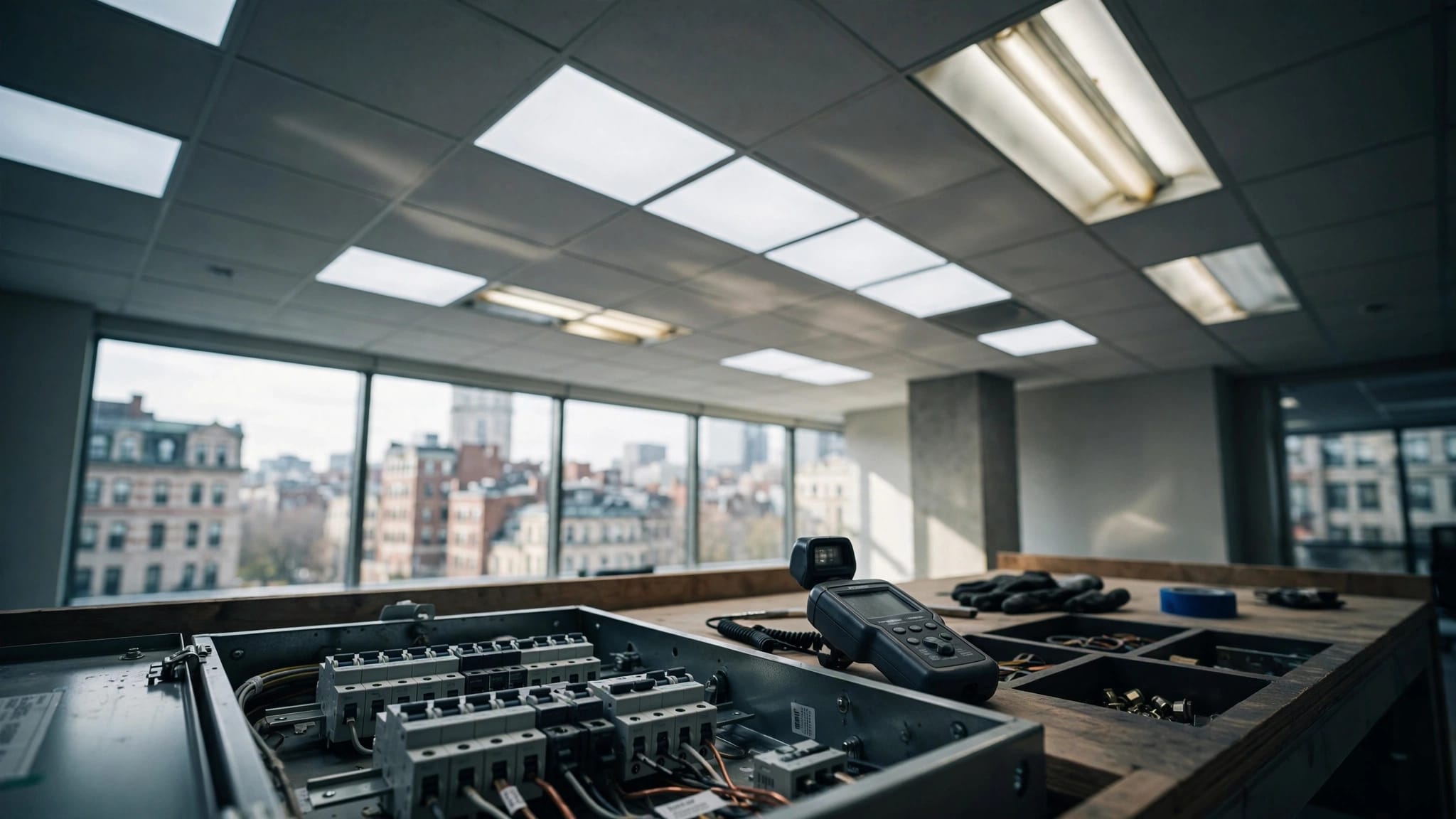
A lighting upgrade can lose its expected value before the first fixture arrives if the scope misses controls, access costs, or incentive deadlines. For Greater Boston property owners, a commercial LED retrofit starts with understanding how the building operates.
The strongest plan balances lighting quality with energy use, maintenance needs, and installation timing. Before ordering equipment, establish the existing conditions and confirm which requirements apply to your property.
Key Takeaways
- Start with a documented audit, including fixture wattage, operating hours, controls, and emergency lighting.
- Confirm the applicable code path and incentive requirements before purchasing equipment or scheduling installation.
- Compare complete project costs, then phase the work around occupants and verify performance before closeout.
Start Your Commercial LED Retrofit With an Audit
A fixture count alone isn't enough for a reliable proposal. Your electrician needs to understand the wiring, ceiling conditions, and daily use of each space.
Record equipment and electrical conditions
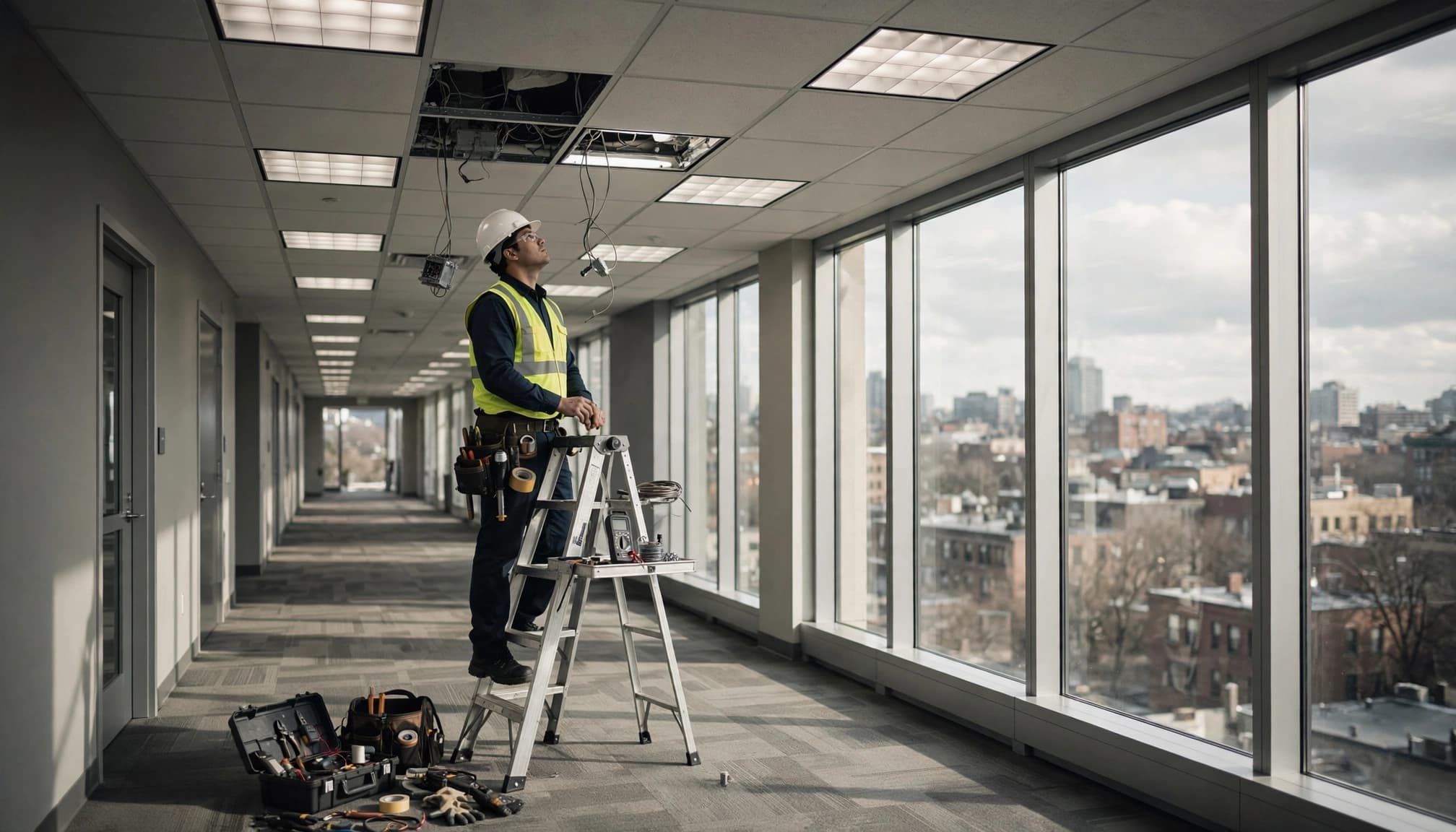
Document fixture types, quantities, lamp and ballast combinations, input wattage, mounting heights, and existing controls. Also identify damaged housings, inaccessible junction boxes, and circuits serving emergency lighting.
In older commercial properties, previous renovations may have left mixed lamps, dimmers, and wiring methods. Therefore, verify conditions in the field rather than relying entirely on old drawings.
Keep emergency fixtures and exit signs identifiable throughout the audit. Their power sources and operating requirements need separate attention.
Separate spaces by use and schedule
An office, loading dock, and stairwell rarely need the same lighting strategy. Record actual operating schedules, including cleaning crews, security rounds, and weekend occupancy.
Measure illumination at relevant work surfaces and note glare, shadows, or uneven coverage. Ask occupants where visibility causes problems.
This baseline supports both design decisions and savings estimates. Sirois Electric's commercial lighting maintenance and retrofits address lighting within the broader electrical needs of a business property.
Choose Fixtures for Performance and Serviceability
Select equipment after defining the lighting requirements. A lower-wattage fixture won't solve poor distribution, glare, or an unsuitable mounting arrangement.
Decide what stays and what gets replaced
LED lamps can preserve suitable existing housings, but compatibility matters. Ballast-compatible products require matching ballasts; ballast-bypass products involve wiring changes and product-specific installation instructions.
Retrofit kits offer another option when the housing remains sound. Complete fixture replacement may make more sense when housings are damaged or the current layout performs poorly.
Compare these approaches using installed cost, remaining components, maintenance access, and warranty coverage. Existing equipment condition should drive the decision, rather than fixture price alone.
Specify light quality and replacement parts
The specification should identify light output, distribution, color temperature, and color rendering. For retail displays, merchandise appearance deserves attention alongside illumination levels.
Request a sample installation where glare or appearance could affect acceptance. Review it during normal operations before approving the full order.
For warehouses and exterior areas, check temperature ratings, moisture exposure, and mounting requirements. Greater Boston's seasonal conditions make outdoor product suitability important.
Finally, ask whether drivers and control components are replaceable. A long-rated LED light source doesn't establish how easily the complete fixture can be repaired.
Design Controls Around Operations and Code
Controls should respond to actual occupancy while meeting the project's applicable energy requirements. Specify the control sequence alongside the fixtures.
Match control zones to each space
Occupancy sensors suit intermittently used spaces, but their placement must match room geometry. In warehouse aisles, shelving can obstruct detection.
Daylight-responsive controls can reduce electric lighting near windows or skylights. However, those zones need separate consideration from interior areas.
Define manual overrides, dimming levels, sensor delays, and after-hours behavior. Then test whether occupants can use the system without routinely defeating it.
For retail projects, review commercial lighting controls for retail spaces when coordinating display lighting, daylight zones, and switching.
Confirm the applicable permit and energy-code path
Massachusetts identifies its current building code as 780 CMR, 10th Edition . The commercial Base Energy Code uses the 2021 IECC with Massachusetts amendments.
Municipal Stretch and Specialized Code adoption varies. Electrical requirements also follow the applicable Massachusetts electrical code and amendments.
Ask the local building department and wiring inspector which provisions apply to your scope. A limited replacement, substantial alteration, and first-time tenant fit-out can receive different treatment.
Efficient fixtures alone don't establish compliance. Installed lighting power, controls, emergency systems, and documentation may also affect approval.
Check Current Incentives Before Ordering
Incentive timing can affect procurement. As of October 2026, Mass Save has distinct retrofit and instant-incentive pathways, with different eligibility and purchasing rules.
Under Mass Save's existing-lighting retrofit pathway, eligible existing commercial electric customers include Cape Light Compact, Eversource, National Grid, and Unitil customers. Lighting must operate at least 2,000 hours annually .
That pathway requires sponsor pre-approval before purchasing or installing equipment. Qualifying equipment must be installed within 12 months after pre-approval.
The instant pathway changed on January 1, 2026, when incentives for non-controlled lighting products ended. Published controlled-product categories include these amounts:
| Qualifying product category | Published instant incentive |
|---|---|
| Interior fixture with qualifying controls | $60 per fixture |
| High- or low-bay fixture with qualifying controls | $70 per fixture |
| Exterior fixture with an occupancy sensor | $70 per fixture |
These figures aren't a guaranteed project rebate. Confirm current product eligibility, participating distributors, and sponsor terms before ordering through the instant lighting incentive program.
Ask whether the proposed products meet applicable DesignLights Consortium (DLC) qualification requirements. Also confirm whether incentives apply at purchase or require a separate application.
For pre-approved projects, retain application documents, specifications, costs, and anticipated savings. The cited retrofit form calls for final documentation within 30 days after installation; follow any different instructions from your sponsor.
For the pre-approved retrofit pathway, purchasing equipment before sponsor approval can put the expected incentive at risk.
Estimate Energy and Maintenance Savings Separately
A useful savings estimate shows its assumptions. Request existing and proposed total input wattage , including ballast or driver consumption, rather than comparing lamp labels alone.
Calculate annual electricity reduction using the wattage difference, annual operating hours, and division by 1,000. For controls, model each zone's expected schedule separately.
Use recent utility bills to select an appropriate electricity rate. Demand-charge savings require additional analysis because reducing lighting doesn't always reduce the building's billing peak.
Maintenance savings also need a baseline. Review lamp purchases, service calls, lift rental, and staff time over a representative period. Then compare those costs with the proposed system's maintenance needs.
LEDs can reduce replacement frequency, but drivers and sensors still require service. Warranty terms may also exclude labor or access equipment.
For simple payback, divide net installed cost by estimated annual financial savings. Identify whether that estimate includes maintenance.
Avoid counting unconfirmed incentives as settled revenue. Likewise, keep HVAC effects separate unless the analysis supports them. Lighting changes can affect heating and cooling loads differently across seasons.
Phase Installation Around Building Operations
Occupied offices, restaurants, and distribution facilities need an installation plan that protects normal operations. Agree on the sequence before crews arrive.
Coordinate access, outages, and occupant notices
Divide the building into workable zones. Coordinate ceiling access, furniture moves, deliveries, and lift routes with the property manager.
Schedule noisy work and necessary outages around business activity. Although evening work can limit disruption, it may increase labor costs.
For leased spaces, confirm landlord approval and access responsibilities. Building rules may also restrict work hours or require protection of common areas.
Maintain safe circulation and coordinate any temporary lighting arrangements before removing fixtures.
Test a pilot area before expanding
Complete one representative area first when practical. Check light quality and control behavior under actual operating conditions.
Then use the findings to resolve glare, missed sensor coverage, or unsuitable dimming levels before repeating the installation.
Inspect and test each completed phase before moving on. This approach helps identify recurring issues while the affected area is still manageable.
The schedule should also accommodate inspections and appropriate disposal of removed lamps, ballasts, and fixtures.
Compare Complete Bids and Require Closeout Records
Comparable bids need a shared scope. Each proposal should identify fixture models, quantities, controls, wiring changes, access equipment, work hours, and testing responsibilities.
Also clarify permits, ceiling repairs, disposal, incentive paperwork, and exclusions. A low fixture price can conceal substantial installation costs.
For a commercial LED retrofit, agree on how unexpected conditions will affect price and scheduling. Concealed wiring problems deserve a defined approval process.
Sirois Electric's commercial LED lighting installation can be coordinated with the property's electrical conditions and operating needs.
At completion, collect product specifications, warranties, sensor settings, commissioning results, and updated circuit information. Record emergency-lighting changes and the final control zones.
Clear lighting and controls documentation helps future technicians understand the installation. It also reduces reliance on whoever remembers the original project.
Before final acceptance, identify who handles warranty claims and who retains incentive submission records.
Frequently Asked Questions
How long does a commercial lighting retrofit take?
The schedule depends on fixture quantities, access conditions, wiring changes, procurement, and permitted work hours. Incentive approval and inspections can also affect timing.
Ask for a schedule that separates approval, ordering, installation, and closeout. An installation-only estimate won't show the full project timeline.
Does LED lighting require a panel upgrade?
A panel upgrade isn't automatic. Although LEDs generally reduce lighting load, the electrician still needs to assess circuit condition and the proposed wiring changes.
Existing safety problems or additional work may require electrical improvements. Empty breaker spaces alone don't establish adequate capacity for other equipment.
Who pays when the building is leased?
The lease and project agreement determine responsibility. Confirm who owns the fixtures, pays the electric bill, approves modifications, and submits incentive paperwork.
Resolve those questions before approving the scope, particularly when the landlord and tenant share project costs.
Build the Plan Before Buying the Fixtures
A dependable retrofit starts with a documented baseline, suitable equipment, and a realistic installation sequence. Code review and incentive confirmation belong before procurement.
Keep verified performance at the center of the project: appropriate illumination, functioning controls, and complete records. That preparation gives Greater Boston building owners a sound basis for evaluating costs and expected savings without relying on promises.