
Landscape Lighting Transformer Sizing for Massachusetts Homes

Contact Us
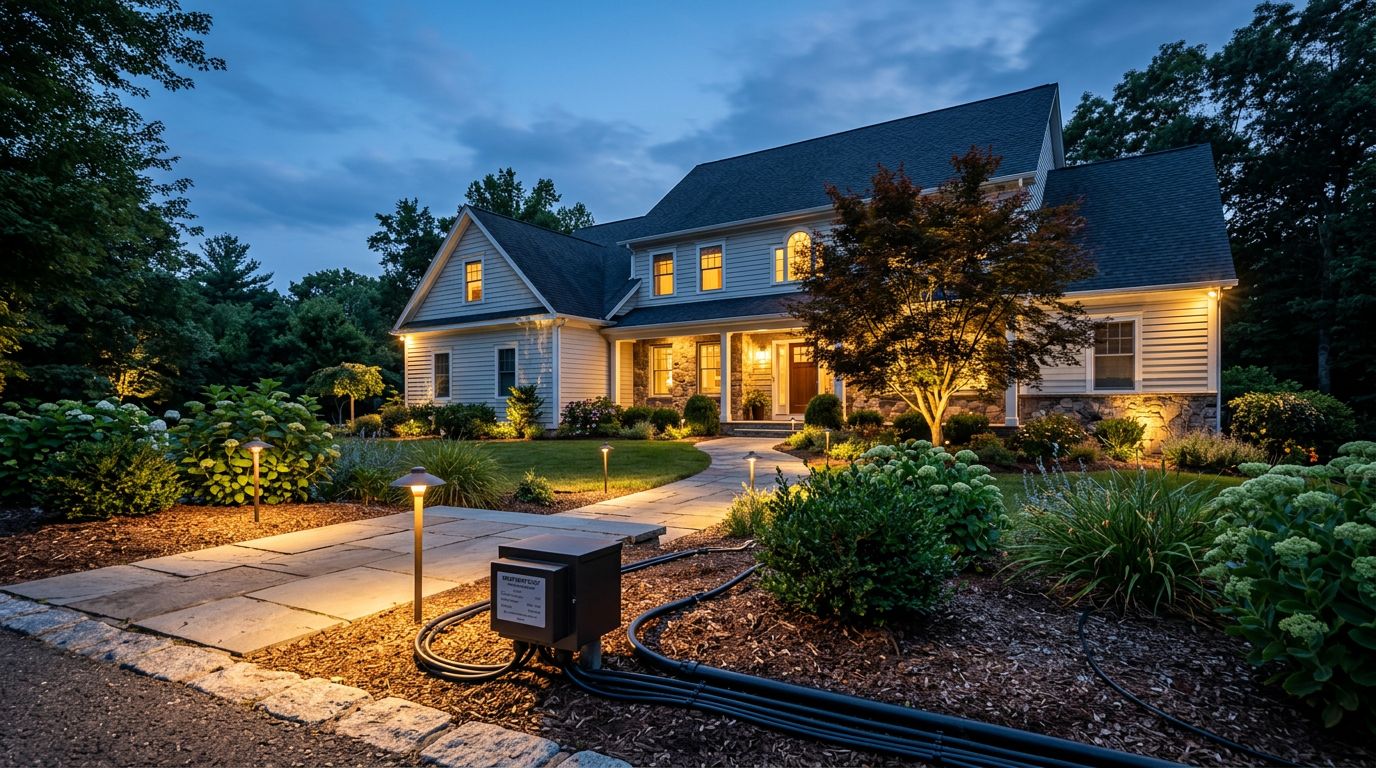
Dark spots around a walkway usually point to a design problem, not a shortage of fixtures. The right landscape lighting transformer sizing balances the total fixture load, cable length, voltage drop, output voltage, and outdoor safety requirements.
An undersized transformer can run hot, dim distant lights, and leave no capacity for future additions. An oversized unit isn't automatically better either. The transformer must match the system design and the fixtures installed. Before choosing a size, start with the electrical load and then review the cable layout.
landscape lighting transformer sizing: Start With the Load
A transformer changes household voltage into the lower voltage used by many outdoor lighting systems. Most residential landscape systems use 12V, 15V, or another low-voltage output specified by the fixture manufacturer.
The transformer must match the required output voltage. It also needs enough capacity for every connected fixture, including lights that may be added later.
VA and watts are related, but they aren't identical
Manufacturers usually rate landscape lighting transformers in volt-amperes, or VA . Fixtures often list their power consumption in watts. Watts measure real power use, while VA measures the apparent electrical load placed on the transformer.
For a basic residential LED system, the fixture wattage provides a practical starting point:
Total connected load = fixture 1 watts + fixture 2 watts + all other fixture watts
Then compare that total with the transformer VA rating. The selected transformer should meet or exceed the calculated load, subject to the manufacturer's instructions.
LED drivers can have power factors that make their VA load differ from their wattage. If the fixture or driver lists VA, use that value instead of assuming watts and VA are identical.
Match the transformer to the fixture voltage
A transformer with enough VA can still be the wrong choice if its output voltage doesn't match the lighting equipment. Check the fixture specifications, transformer taps, and installation instructions before connecting anything.
A 12V fixture connected to an unsuitable output can produce poor performance or shorten the life of the lamp and driver. The voltage requirement matters just as much as the capacity rating.
How to Calculate the Transformer Capacity
Good landscape lighting transformer sizing begins with a fixture schedule. Write down each fixture type, its quantity, and its rated wattage. Include path lights, wall washes, accent lights, step lights, and any future fixtures included in the plan.
Add every fixture's rated load
Suppose a Massachusetts homeowner plans this installation:
- Eight path lights at 4 watts each equal 32 watts.
- Four shrub uplights at 7 watts each equal 28 watts.
- Two tree-mounted accent lights at 9 watts each equal 18 watts.
The total connected load is:
32W + 28W + 18W = 78W
A practical first-pass calculation would call for a transformer rated at least 78 VA. The transformer should also have capacity for conversion losses, the actual VA of LED drivers, and reasonable future expansion.
The available product sizes may not match the exact calculation. In that case, select the next suitable listed capacity after confirming the manufacturer's load limits and wiring requirements.
Worked example: 78 watts on a 100 VA transformer
A listed 100 VA outdoor transformer would provide 22 VA above the 78W fixture estimate. That may be adequate for a short, well-planned system with no immediate expansion.
However, the same 78W load on a long cable run may need a different layout, heavier cable, or a larger transformer. A 150 VA unit could provide more room, but it isn't automatically the correct answer. The cable length, conductor size, output voltage, fixture type, and number of zones still control the design.
A transformer can have enough capacity on paper and still produce dim lights when the cable layout creates excessive voltage drop.
Account for Cable Length and Voltage Drop
Low-voltage systems operate with less electrical pressure than standard household circuits. As a result, voltage loss along the cable can affect light output more noticeably, especially on long runs.
The risk increases when many fixtures share a small-gauge cable. Distant lights may appear dimmer than fixtures near the transformer, even though the transformer has sufficient VA capacity.
Use cable size and layout to control voltage drop
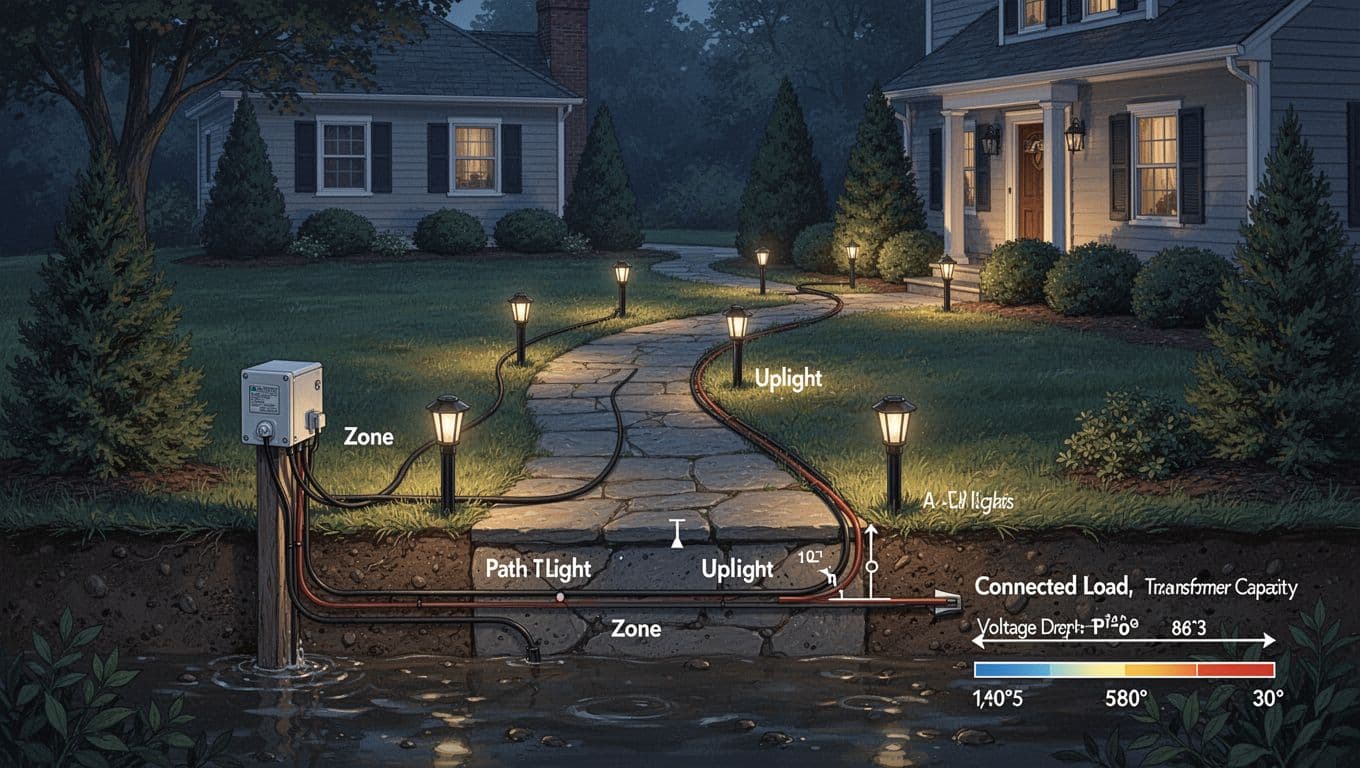
During landscape lighting transformer sizing, calculate the load for each cable run, not only the total load at the transformer. A run with several fixtures and substantial distance can lose more voltage than a short run with the same total wattage.
Installers commonly reduce voltage drop by using heavier-gauge cable, shortening runs, splitting fixtures into separate circuits, or placing fixtures in multiple zones. The manufacturer's voltage-drop chart can help determine the correct conductor size and maximum run length.
The NEC doesn't establish one universal landscape-lighting voltage-drop percentage for every residential design. Therefore, a qualified installer should base the decision on the equipment specifications and the actual site layout.
Divide fixtures into practical lighting zones
Separate zones can improve both performance and control. For example, path lights along a front walk may use one run, while tree uplights in the backyard use another. This arrangement can keep high-load or long-distance fixtures from sharing one weak run.
Zones also make troubleshooting easier. If one cable connection develops a problem, the rest of the property can continue operating. Each zone still needs correct polarity, suitable cable, secure connections, and a load within the transformer's rating.
Massachusetts Rules for the 120V Supply Side
Low-voltage lighting doesn't remove the need for safe electrical work. The household supply feeding the transformer is still a 120V electrical installation and must follow the current Massachusetts Electrical Code and local requirements.
Use GFCI protection where it applies
For a dwelling, the outdoor receptacle or branch circuit supplying a landscape lighting transformer generally falls under NEC GFCI requirements, including provisions referenced in NEC 210.8(A)(3) and 210.8(F). The exact application depends on the installation and the current code adopted in Massachusetts.
The GFCI protection belongs on the supply side. It protects the 120V receptacle or circuit feeding the transformer, rather than turning the low-voltage output into a household branch circuit.
Outdoor receptacles also need weatherproof protection. An in-use cover may be required where a cord remains connected, and the enclosure must be suitable for the outdoor location.
Know when the supply becomes electrical construction
A basic plug-in system connected to an existing, compliant outdoor receptacle may be treated differently from a hardwired transformer or a new outdoor outlet. Permit practices and enforcement can vary by Massachusetts municipality.
Adding a receptacle, extending a 120V branch circuit, installing a new dedicated circuit, or hardwiring the transformer deserves review by a licensed Massachusetts electrician. The electrician can check panel capacity, grounding, GFCI protection, weatherproof equipment, and local permit requirements.
Low-Voltage Installation Still Needs Safe Workmanship
The lighting side usually operates at 30V or less, but it still requires equipment and installation methods suited to outdoor use. NEC Article 411 addresses low-voltage lighting, while NEC Table 300.5 provides burial guidance for listed low-voltage landscape circuits.
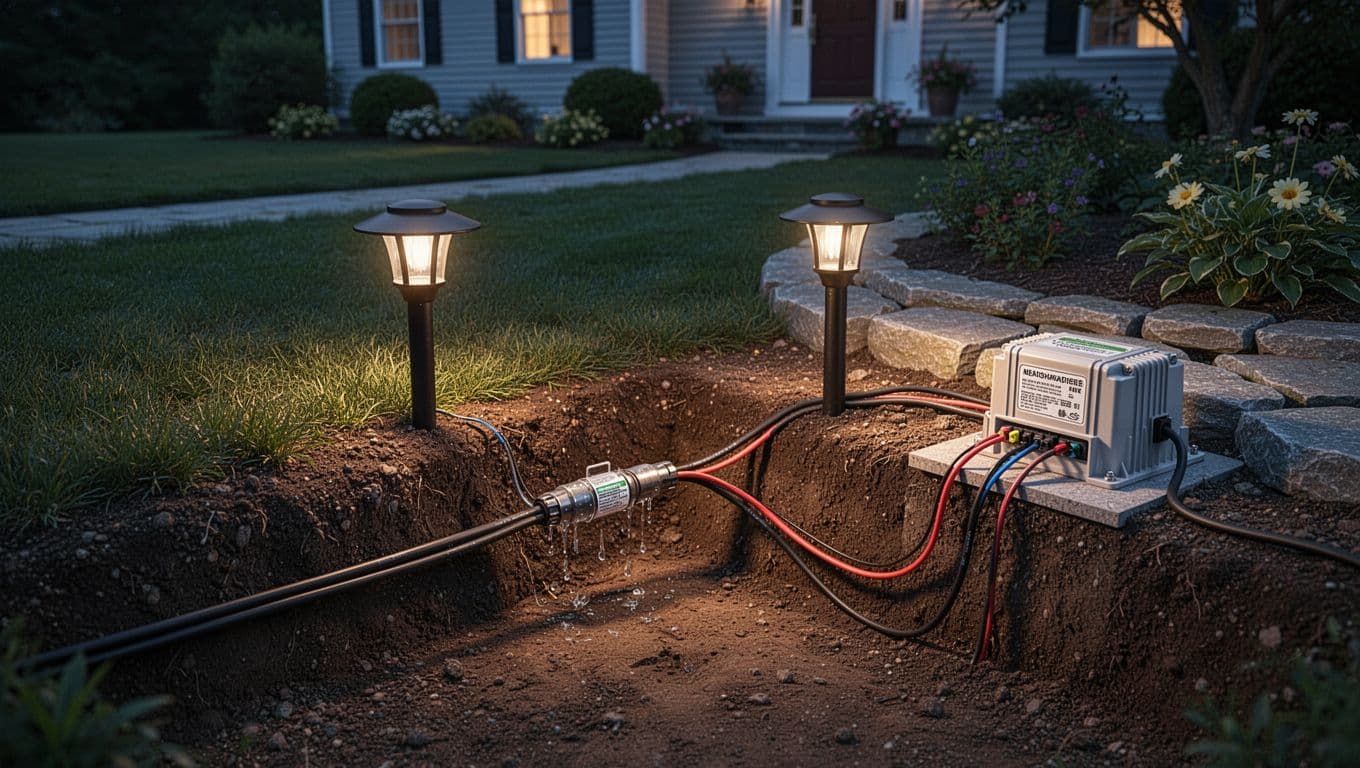
Choose listed transformers and outdoor-rated connections
Use a transformer listed for the intended outdoor application. Follow its mounting instructions, load limits, output settings, and connection requirements. The enclosure should remain accessible for service and protected from locations where water collects.
Every underground splice needs a connector listed for wet locations and direct burial when the connector will remain underground. Standard indoor wire nuts and tape don't provide the same protection against moisture, corrosion, and soil movement.
Keep connections out of standing water and use the fixture manufacturer's recommended cable and connector system. Before digging, identify utility lines and plan the cable route around irrigation, hardscape, drainage, and future planting.
Bury cable with enough cover
NEC Table 300.5-based guidance supports at least 6 inches of cover for listed low-voltage landscape lighting circuits rated at 30V or less. Cover means the soil above the cable, not simply the depth of an open trench.
Many professional installations place cable 8 to 12 inches deep where practical. Extra depth can reduce damage from aerators, edging tools, planting, and routine yard maintenance.
At each fixture, leave enough slack to reposition the light or make a future repair. Avoid burying a splice at a shallow bend or directly beneath a hardscape edge where later work could damage it.
When a Massachusetts Electrician Should Verify the Design
A licensed electrician should review the project when the installation affects the home's 120V wiring. That includes a new outdoor receptacle, a hardwired transformer, a new branch circuit, panel work, or any connection inside the service equipment.
Professional review also makes sense when the lighting plan covers a large property, includes several long cable runs, or combines multiple transformer zones. A calculation based only on total fixture watts can miss voltage drop, driver VA, cable routing, and output-tap limits.
Ask the electrician to verify:
- The transformer is listed for outdoor use and matches the fixture voltage.
- The connected load stays within the transformer's VA rating.
- Each zone has suitable cable size and acceptable voltage at the farthest fixture.
- The 120V supply has required GFCI protection and weatherproof equipment.
- Buried cable and connectors meet the installation requirements.
- The work follows the current Massachusetts Electrical Code and local inspection process.
Homeowners in Burlington and surrounding communities can review professional outdoor lighting installation options when they want a site-specific design rather than a guess based on transformer size alone. If the project includes existing wiring concerns, Burlington electrical inspections can help identify supply-side problems before installation begins.
Conclusion
Landscape lighting transformer sizing depends on more than adding fixture wattages. The correct design matches the transformer VA rating and output voltage to the fixtures, then accounts for cable length, voltage drop, zones, and future changes.
For Massachusetts homes, the 120V supply needs appropriate GFCI protection and weatherproof equipment. The low-voltage side still needs listed products, sealed connections, and proper burial depth. When the project adds or changes household wiring, a licensed Massachusetts electrician should verify the design before work begins.