
How to Map Electrical Circuits in an Older Greater Boston Home

Contact Us
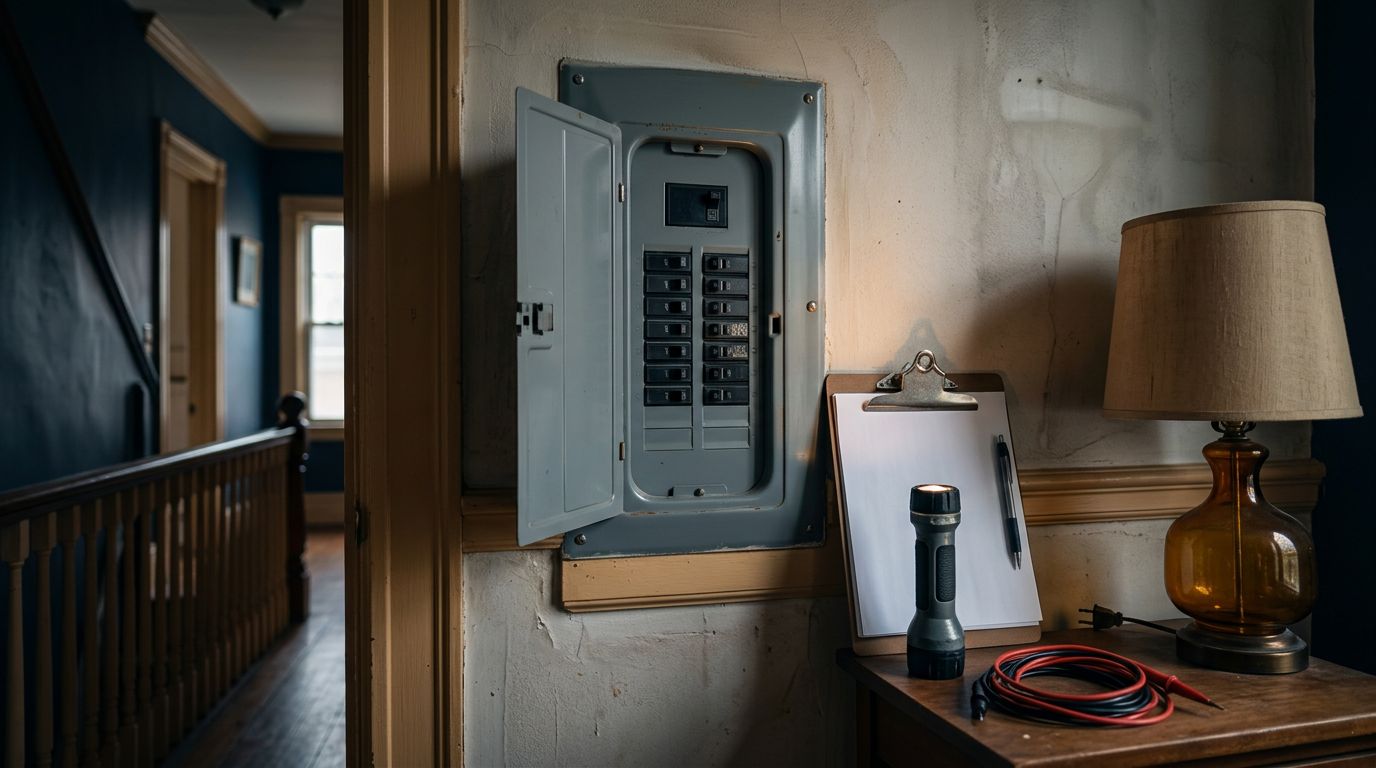
An older home can have a panel directory that looks complete but tells only half the story. Additions, remodels, and past repairs often leave breakers mislabeled, so learning to map electrical circuits gives you a clearer picture of what each breaker actually controls.
A careful map helps during an outage, a renovation, or a service call. Keep the work limited to normal breaker operation and accessible testing. Never remove the panel cover, touch wiring, alter connections, or work on energized equipment.
Start With a Safe, Useful Goal
Circuit mapping identifies the relationship between a breaker and the lights, outlets, and hardwired equipment that lose power when that breaker is off. It does not reveal every wire behind plaster walls or confirm that an old circuit meets current code.
Use only the breaker handles behind the normal panel door. Do not unscrew the deadfront cover, reach into the panel, or touch anything except the insulated breaker handle. If the panel feels warm, makes a buzzing sound, has corrosion, or lacks a secure cover, stop before opening the door.
Clear the area around the panel
Remove stored boxes, paint cans, and furniture from the panel area. The floor should be dry, well lit, and free of trip hazards.
Before testing, tell everyone in the home that power may go off briefly. Avoid mapping during a storm or when someone depends on medical equipment, a sump pump, a furnace, or a home office setup that cannot lose power.
Protect appliances and electronics first
Turn off computers, televisions, gaming systems, and other sensitive electronics before testing. Check refrigerators, freezers, aquariums, Wi-Fi equipment, and garage-door openers, too.
A breaker may feed more than one room. In an older Greater Boston home, one circuit can cover a bedroom, hallway light, basement outlet, and an unexpected appliance.
Gather Simple Tools Before You Map Electrical Circuits
You don't need specialty electrical tools to create a useful first-pass directory. A helper, a circuit tester, and organized notes will give you better results than rushing through the panel alone.
Use non-invasive testing tools
Bring a plug-in outlet tester for three-prong receptacles, a non-contact voltage tester, a clipboard or notebook, masking tape, and a phone camera. A small lamp is also useful for two-prong outlets that cannot accept a three-prong tester.
Test the plug-in tester in a known working, grounded outlet before and after the session. The non-contact tester can warn that voltage may be nearby, but it cannot prove wiring inside a box is dead. Never treat either tool as permission to remove an outlet, switch, or fixture cover.
Work with a helper in the house
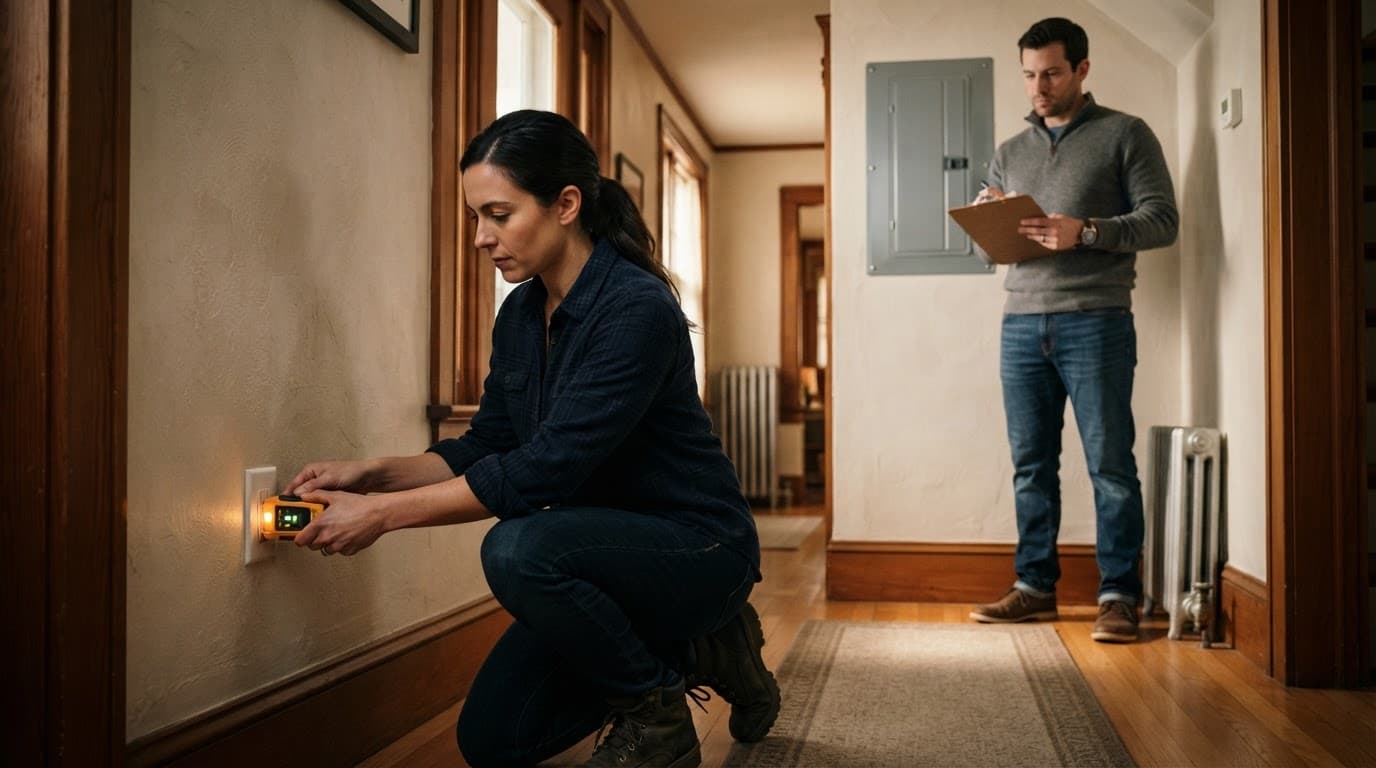
One person stays at the panel while the other checks rooms. Agree on a simple calling method, such as "breaker 12 off" and "second-floor bedroom outlets dead."
The helper should test outlets with the plug-in tester, operate lights with their normal wall switches, and check known loads such as a bathroom fan or garage-door opener. Don't pull out appliances or move furniture to reach hidden outlets.
How to Map Electrical Circuits Safely, One Breaker at a Time
Start with a breaker that has a readable number or position. Work methodically around the panel, rather than jumping between rooms or turning off several breakers at once.
Follow the same sequence for every breaker
- Record the breaker number, location in the panel, and any existing label before moving it.
- Have your helper confirm that the test lamp, outlet tester, or fixture works while the breaker is on.
- Turn that one breaker fully off using only its handle. Never force a stiff, damaged, or loose breaker.
- Ask the helper to check accessible outlets, lights, fixed appliances, and exterior receptacles in a planned room-by-room order.
- Record every device that went off, then restore the breaker and confirm that power returns before moving to the next one.
A breaker that appears to control only one outlet may also supply a closet light or outdoor receptacle. Record what you confirmed, not what you assume.
Verify the device is actually off
A plug-in tester with no lights usually shows that a three-prong receptacle has lost power. For a light fixture, confirm it worked before the breaker was switched off and returns after the breaker is restored.
A dark fixture alone does not prove its wiring is safe to touch. A burned-out bulb, a wall switch, or a second circuit can confuse the result. Because you are not removing covers or accessing conductors, record the fixture as "off with breaker" and leave electrical repairs to a licensed electrician.
A circuit map identifies normal operation. It does not replace the electrical safety checks required before anyone works on wiring or a fixture.
Record Results While They Are Fresh
Notes become unreliable when you wait until the end of the day. Write down each finding as your helper reports it, including any surprise rooms or devices.
Create a circuit log before labeling the panel
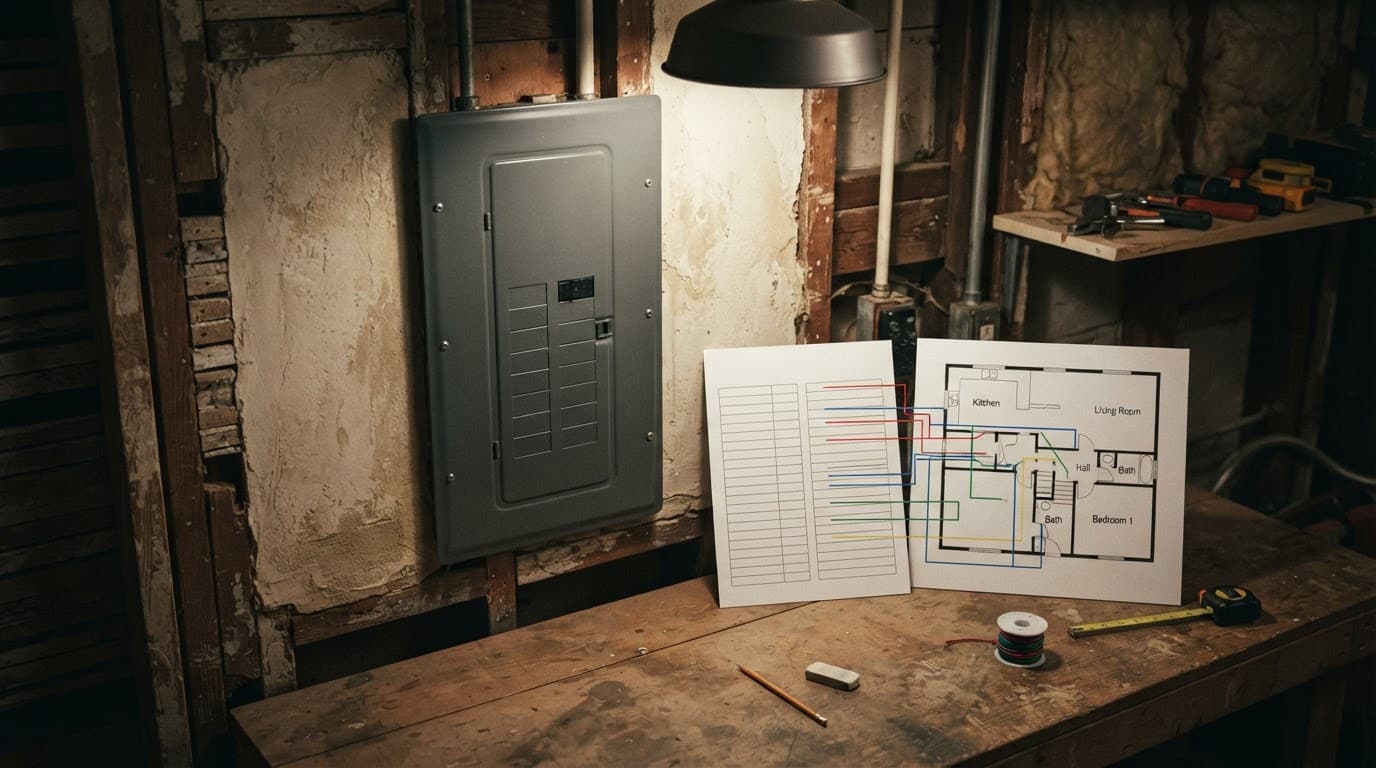
Use one row per breaker. Include rooms, confirmed devices, and anything unusual, such as a tripped GFCI receptacle or a circuit that may serve more than one area.
| Record | What to write |
|---|---|
| Breaker number or position | Copy the number or panel position exactly. |
| Rooms confirmed | List each room where power went off. |
| Devices confirmed | Note outlets, lights, fans, appliances, and exterior receptacles. |
| Protection details | Record nearby GFCI reset buttons or AFCI breaker markings. |
| Shared or unexpected loads | List anything outside the expected area that lost power. |
A simple floor plan can help, especially in a house with finished basements, attic rooms, porches, or additions. Mark uncertain findings with a question mark instead of guessing.
Write labels people can understand
"Kitchen outlets" is too broad if one breaker also runs the pantry, dining-room receptacles, or under-cabinet lights. Better labels name the area and the main loads, such as "Kitchen counter outlets, pantry" or "Second floor front bedroom, hall light."
Keep suspected shared circuits separate from confirmed ones. That distinction helps an electrician trace the issue later without relying on an inaccurate label.
Watch for Legacy Wiring and Protective Devices
Older Greater Boston homes often combine original electrical work with several generations of upgrades. That mix calls for extra care during even basic circuit mapping.
Treat older wiring clues seriously
Knob-and-tube wiring was common in American homes from the 1880s through the late 1940s. It has no equipment-grounding conductor by design, and it may remain hidden in walls, attics, or crawl spaces. Don't lift insulation, enter tight spaces, or try to follow it yourself.
Two-prong receptacles also point to an ungrounded circuit. A three-prong plug-in tester cannot test them, and a grounding adapter does not create a safe equipment ground. Use a known working two-prong lamp only to identify whether the outlet loses power.
Some mid-century homes have aluminum branch wiring. Don't remove an outlet or panel cover to look for it. If an inspection report, prior owner, or visible documentation mentions aluminum wiring, put that note on your map and have a Massachusetts-licensed electrician assess it.
Note GFCI and AFCI behavior
A GFCI receptacle can protect other outlets downstream, sometimes in a different room. If a bathroom, garage, basement, kitchen, or exterior outlet goes dead, look for an accessible GFCI reset button before assuming a breaker has failed.
AFCI breakers can trip when they sense certain electrical faults. Don't repeatedly reset a breaker that trips during normal use. Record the breaker number, what was plugged in, and what happened before it tripped.
Know When to Stop and Call a Licensed Electrician
Massachusetts licenses master electricians and journeyman electricians, and hired electrical work belongs with a licensed professional. Your notes can speed up that visit, but they should never become a repair plan.
Stop mapping immediately if you find a warning sign
- The panel is hot, smells burned, buzzes, or shows rust, water stains, or melted plastic.
- A breaker will not stay on, feels loose, or trips again after a single reset.
- Lights flicker when appliances start, or outlets feel warm during normal use.
- You find a two-prong outlet with scorch marks, cracks, or a loose faceplate.
- One breaker shuts off devices in unrelated areas with no clear pattern.
- You suspect knob-and-tube wiring, aluminum branch wiring, or exposed splices.
- Extension cords and power strips carry regular loads because outlets are limited.
Frequent trips and overloaded circuits need more than a new label. They need a trained evaluation of the panel, wiring condition, and electrical demand.
Use your map as an inspection tool
An accurate circuit log gives an electrician a useful starting point for tracing shared circuits, adding receptacles, upgrading a panel, or planning a renovation. It also shows where an old directory may hide a larger issue.
If your notes reveal legacy wiring, recurring trips, or unclear grounding, schedule one of the home electrical inspections in Greater Boston before starting electrical work.
Turn Your Notes Into a Durable Panel Directory
Once every tested breaker has been restored, transfer confirmed findings to a clean directory. Use the panel's directory card if it is intact, or place a clear typed or handwritten list inside the panel door.
Keep labels detailed and current
Include breaker number, room names, and major fixed loads. Mark a circuit as "shared, verify" when your testing found a possible overlap.
Avoid covering breaker handles or placing tape over the panel face. Keep a dated photo of the completed directory on your phone, along with a copy of your floor plan.
Update the map after electrical work
Renovations, panel work, new appliances, EV chargers, and added lighting can change a circuit's purpose. Ask the electrician to update the directory after completed work, then replace your saved copy.
A useful directory stays accurate because it changes when the house changes.
A Clear Circuit Map Makes the Next Step Safer
Older homes rarely reveal their electrical history in one afternoon. Still, careful notes can turn an unreliable panel directory into a practical record of what each breaker controls.
The safest map comes from patient testing, honest uncertainty, and clear limits. Never open the panel cover or work on wiring to fill in the blanks.