
Massachusetts Wall Oven Electrical Requirements

Contact Us
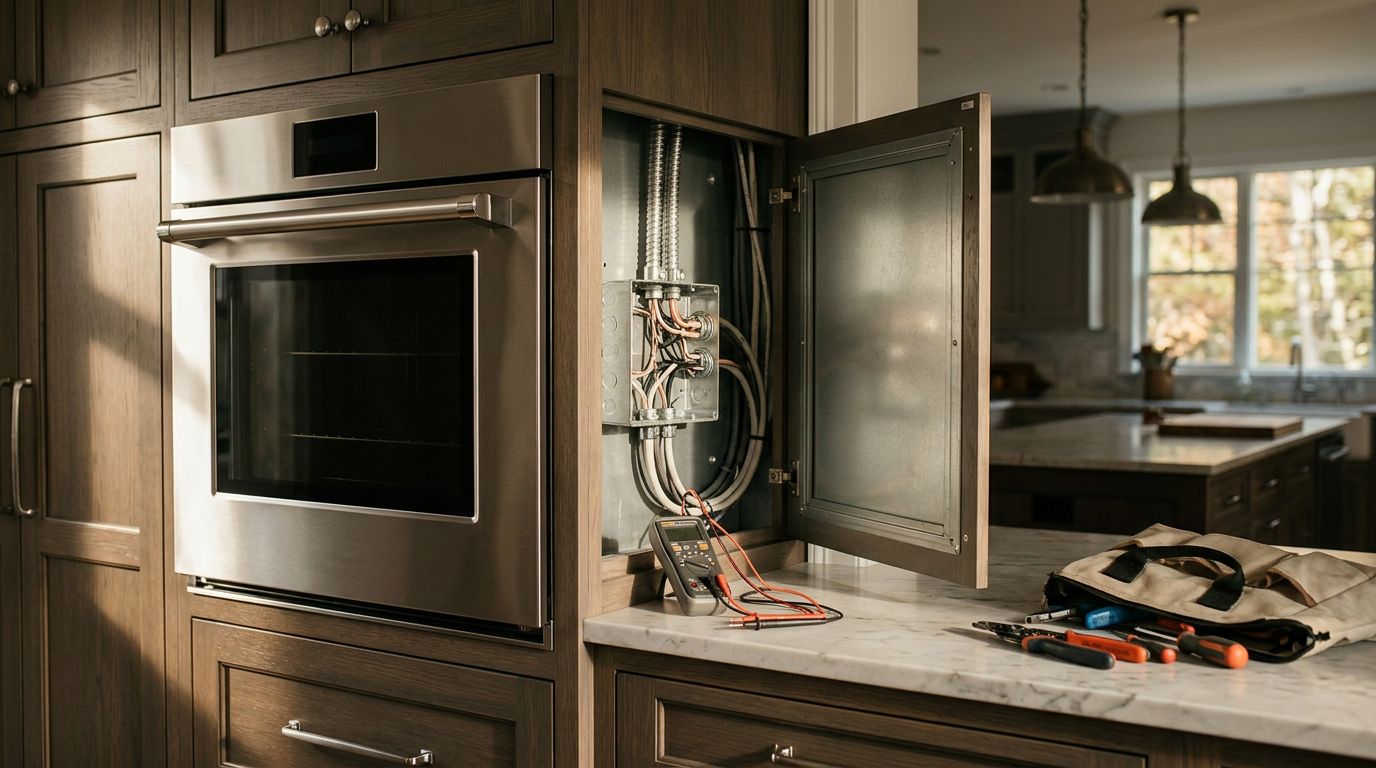
Massachusetts wall oven electrical requirements depend on the oven's listed installation instructions, its electrical rating, and the state code governing the permit. A safe installation needs a properly sized circuit, suitable grounding, and required inspections before concealed wiring disappears behind finished walls.
Even when a replacement oven fits the existing cabinet, its electrical needs may differ. Start with the exact model , then plan the circuit and permit scope around it.
Key Takeaways
- Massachusetts adopted its 2026 Electrical Code effective April 24, 2026.
- Oven voltage, breaker size, and wiring requirements depend on the specific model.
- New installations need an equipment-grounding path, with the neutral kept separate where required.
- Electrical permits and inspections are administered by the local Inspector of Wires.
- Existing wiring needs evaluation before it supplies a larger or differently rated oven.
Massachusetts Code and Permit Requirements
Which electrical code applies?
Massachusetts regulates electrical installations through 527 CMR 12.00 . The 2026 Massachusetts Electrical Code incorporates the 2026 edition of NFPA 70, the National Electrical Code, with state amendments.
The edition took effect April 24, 2026, and applies to installations whose permits were granted after that date. The electrical permit date matters, rather than the oven's purchase date or delivery date.
Manufacturer instructions are also part of a compliant installation. An oven's listing, connection diagrams, and supply requirements must fit the applicable code.
Who handles permits and approval?
Electrical work should be handled by a Massachusetts-licensed electrician. State board policy limits electrical permit applications to licensed electricians or electrical contractors.
Adding a circuit, moving a junction box, changing wiring, or making a hardwired connection brings electrical work into the project. A general building permit doesn't replace the electrical permit.
The local Inspector of Wires administers permitting and approval. Forms, fees, inspection scheduling, and documentation procedures can differ among municipalities. Our Massachusetts electrical inspection guide describes the distinction between rough and final inspections.
Read the Oven's Nameplate and Installation Instructions
Start with voltage and rated input
The nameplate identifies the model and electrical ratings. Look for voltage, frequency, watts or kilowatts, and any listed current rating.
Many household wall ovens use a 120/240-volt supply. Some also carry a 120/208-volt rating, which matters in buildings supplied by a 120/208-volt system. An oven must be rated for the voltage available at its connection.
A kilowatt equals 1,000 watts. However, wattage alone doesn't establish the required breaker. Listed installation requirements and applicable cooking-appliance sizing rules also affect the circuit design.
Use the manual for circuit and connection details
The installation manual provides information that may not appear on the nameplate. This includes branch-circuit requirements, copper or aluminum conductor restrictions, connection diagrams, and junction-box placement.
For example, LG's combination wall-oven installation instructions identify a covered appliance rated 7,800 watts at 240 volts and specify a 50-amp breaker . Although 7,800 divided by 240 equals 32.5 amps, that calculation doesn't replace the specified circuit requirements.
Also distinguish the appliance's factory wiring from the building wiring. Factory leads may follow different sizing rules, so their appearance doesn't establish the required supply-conductor size.
Wall Oven Electrical Requirements for Branch Circuits
Dedicated circuits and supply voltage
For a typical household electric wall oven, the electrical design includes an individual 208- or 240-volt branch circuit. Where the listed instructions require an individual circuit, that circuit cannot also supply unrelated appliances.
A standard 120-volt kitchen receptacle circuit cannot supply an oven requiring 120/240 volts. The oven's controls may use 120 volts, while its heating elements use the higher voltage.
Similarly, a separate cooktop doesn't automatically belong on the oven's circuit. Shared cooking-appliance arrangements require a code-compliant design and compatible manufacturer instructions.
Breakers and conductors must work together
Breaker selection must account for the appliance requirements, calculated load, conductor ampacity, and panel compatibility. Household 208- or 240-volt ovens generally use a two-pole breaker that disconnects both ungrounded conductors.
Never increase the breaker size alone to accommodate a replacement oven. The existing conductors, terminals, wiring method, and panel must support the revised installation.
Wire sizing also depends on conductor material, insulation, terminal temperature ratings, and any required ampacity adjustments. A wire-gauge recommendation without that context can be misleading.
Dacor's Modernist 30-inch double wall-oven instructions specify 8 AWG solid copper for the installation described in that manual. That specification doesn't establish the correct wire for another model or wiring method.
An oven's factory leads can be smaller than its building supply conductors. Matching the supply wire to those leads can produce an undersized circuit.
Grounding and Connecting a Wall Oven
New circuits need a separate grounding path
A typical new 120/240-volt oven connection has two hot conductors, a neutral, and an equipment-grounding conductor. The neutral carries current for 120-volt components. The grounding path provides a fault-current route that helps protective devices disconnect power.
These functions must remain separate at the oven for a new four-wire installation. The manufacturer's connection diagram identifies how the chassis grounding connection and neutral are arranged.
An oven using only 240 volts may not need a neutral. Its listed instructions determine the connection, but an effective equipment-grounding path is still required.
Existing three-wire connections need evaluation
Older oven circuits sometimes use a three-wire arrangement that bonds the appliance frame through the neutral. Retaining that arrangement is allowed only when the existing installation meets the applicable code exception and the oven's instructions permit it.
A new oven doesn't automatically make an old three-wire circuit acceptable. Missing grounding, damaged insulation, or an unsuitable neutral connection can require corrective work.
Connections also need an approved junction box, suitable connectors, adequate box capacity, and access for servicing. Supply conductors and the oven's flexible conduit must avoid damage when the appliance slides into the cabinet.
GFCI Protection and Electrical Panel Capacity
Hardwiring doesn't remove GFCI requirements
Plan for GFCI protection on new dwelling-unit wall-oven circuits unless an applicable code exception permits otherwise. A hardwired connection alone doesn't establish an exemption.
Massachusetts includes a temporary exception for certain listed cooking equipment that is incompatible with available manufacturer circuit-protection devices. It applies only under its stated conditions and requires installation and inspection under Rule 11. The exception expires January 1, 2029 .
That provision isn't a blanket exemption for wall ovens. The electrician must apply the protection requirements to the actual circuit, equipment, and installation.
Available breaker spaces aren't enough
An empty panel space doesn't prove that the building has capacity for another major cooking load. The electrical assessment also considers service capacity, feeder capacity, existing loads, and applicable demand calculations.
A panel replacement and a service upgrade are different projects. An oven installation doesn't automatically require either one.
Panel condition and breaker compatibility still matter. With an older Murray electrical panel, for example, the assessment should address suitable breakers and the condition of the existing equipment.
If the project includes a separate cooktop or other new electrical loads, include them in the same planning process.
Plan Wiring Around Required Inspections
New wiring must remain visible until the required inspection permits it to be concealed. Closing drywall, installing insulation, or covering junction locations too early can lead to finished work being opened again.
At rough inspection, the inspector may review cable routing, supports, physical protection, boxes, grounding, and panel work. Our Massachusetts electrical rough inspection guide describes this stage in more detail.
Final inspection follows completion of the permitted work. That review can include appliance connections, covers, circuit identification, protective devices, and access.
Have the oven's installation manual available with the project documentation. The electrician should also coordinate the junction-box location with the cabinet layout before finishes restrict access.
A cabinet cutout that fits the oven doesn't necessarily leave room for its wiring connection. Electrical layout and cabinetry need to be planned together.
Wall Oven Electrical FAQs
Does a double wall oven need two circuits?
Not necessarily. A double wall oven can be one listed appliance supplied by a single branch circuit. Separate ovens installed together may have different requirements.
The number of oven cavities doesn't determine the number of circuits. The equipment's listed supply arrangement does.
Can an existing oven circuit be reused?
Yes, when its voltage, capacity, grounding, conductor condition, and connection arrangement satisfy the replacement oven's requirements and applicable code.
Reusing the cabinet opening doesn't establish electrical compatibility. A replacement that requires a larger circuit may need new conductors, different protection, or other changes.
Does replacing an oven require whole-home rewiring?
An oven replacement doesn't automatically require rewiring the entire property. The electrical scope depends on the existing circuit and the changes needed for the new appliance.
However, defects affecting that circuit need attention. A new code edition also doesn't, by itself, require every unrelated existing circuit to be replaced.
Are commercial installations the same as residential ones?
Not always. A business may have a different supply voltage, distribution system, or listed cooking appliance. Commercial kitchen equipment can also involve additional coordination with other building systems.
Use the actual equipment ratings and installation requirements. Household oven specifications shouldn't be applied to commercial equipment.
Build the Installation Around the Exact Oven
Safe wall oven installation starts with the model's electrical requirements and the Massachusetts code governing the work. Cabinet dimensions alone can't establish whether an existing circuit is suitable.
We help homeowners and businesses in Greater Boston plan electrical installations around equipment ratings, existing wiring, and required inspections.
Bring the oven's model information into the electrical planning before cabinetry closes off access. That gives the circuit, connection, and inspection schedule a place in the project from the start.