
Why Recessed Lights Turn Off in Greater Boston Homes

Contact Us
Recessed lights that shut off on their own are usually warning you about heat, a failing part, or a wiring issue. In Greater Boston, the problem shows up often because many homes mix older ceilings, newer remodels, and tight attic spaces.
When one light keeps going dark after a few minutes, the cause is often simple on the surface and serious underneath. The most common culprit is the fixture's built-in heat protection, but it's not the only one.
Thermal protection is often the first place to look
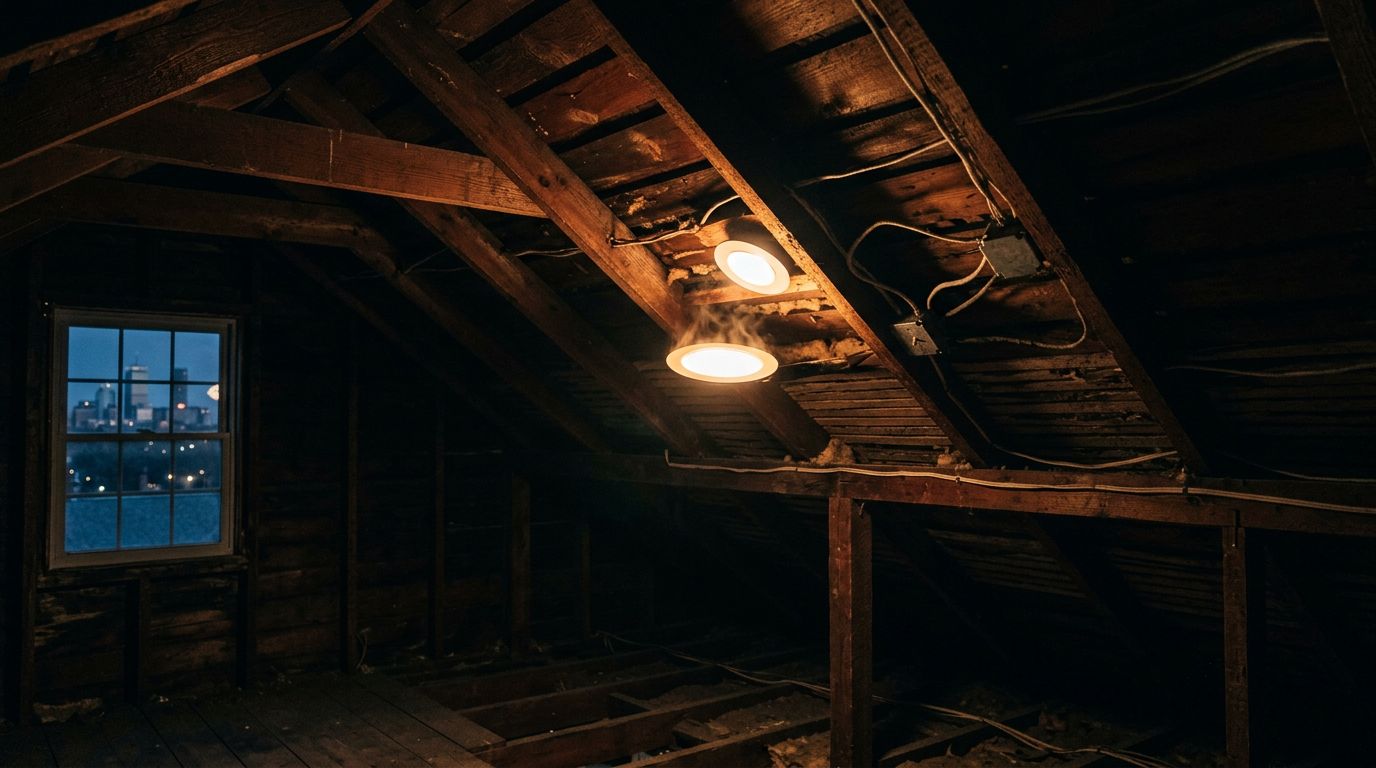
Many recessed fixtures have a safety device that cuts power when the housing gets too hot. That thermal protection is there to keep the fixture from damaging the ceiling or starting a fire.
This usually happens after the light has been on for a while. The fixture may shut off, then work again once it cools down. That pattern is a strong clue that heat is the problem.
Several things can push a recessed light past its safe limit. A bulb that runs hotter than the fixture expects is one. Poor airflow around the can is another. Insulation pressed too close to the housing can trap heat, too.
In older homes, the issue can show up faster. Ceilings may be tighter, insulation may have been added later, and the fixture may not match the space above it. When that happens, the light can act fine in the morning and fail after dinner.
If a recessed light works again after it cools down, heat is usually part of the story.
A fixture that keeps tripping because of heat should not be ignored. Repeated shutoffs mean the light is doing its job, but the ceiling space may not be safe as-is.
Other problems can look like the same thing
Heat is common, but it is not the only reason recessed lights turn off. A weak bulb, a loose connection, or the wrong dimmer can cause the same kind of headache.
Some of the most common causes are easy to tell apart if you watch how the light behaves.
| Cause | What you may notice | Why it matters |
|---|---|---|
| Bad bulb | Flickering, early burnout, or one fixture acting up | The bulb may be failing or the wrong type |
| Incorrect bulb wattage | The fixture feels hot before it shuts off | Too much heat for the housing |
| Incompatible dimmer switch | Shutting off at certain dimmer settings | The dimmer and bulb may not match |
| Loose connection | Light cuts in and out at random | The connection can heat up and fail |
| Non-IC-rated housing near insulation | Repeated shutoffs after warm-up | The fixture may not be safe in that location |
| Fixture age | Frequent outages, discoloration, or buzzing | Parts wear down over time |
A bad bulb is easy to miss because it can act like a wiring issue. Dimmer problems are common, too, especially when older dimmers meet newer LED bulbs. The result is a light that seems fine one minute and unstable the next.
Loose connections are more serious. They can cause the light to flicker, shut off, or come back on later. That kind of behavior often points to heat inside the connection, which is never something to brush off.
Older recessed cans can also fail just because they are old. Springs weaken, contacts wear out, and internal parts stop doing their job. When a fixture has been patched, painted around, or changed a few times, age becomes even more likely.
If you are planning replacements or a lighting refresh, professional electrical services can help match the fixture to the ceiling space and circuit.
Why this comes up so often in Greater Boston homes
Older housing stock is part of the story. Many homes in Greater Boston were not built with recessed lighting in mind, so those fixtures were added later during kitchen, bath, or basement updates.
That matters because retrofits can create tight ceiling conditions. A recessed light that looked fine when it was installed may now sit close to new insulation, framing, or other materials. Heat has less room to escape, so the fixture works harder and shuts down sooner.
This is common in older colonials, triple-deckers, and renovated homes with a mix of old and new work. One room may have modern LED trims, while another still uses older cans or dimmers. When the electrical parts do not match each other, problems show up.
Boston-area homeowners also deal with seasonal changes. Cold weather itself does not cause recessed lights to fail, but insulation upgrades often happen around the same time people start noticing light issues. New insulation can cover a housing that was never meant to be buried.
That is where an IC-rated housing matters. An IC-rated fixture is made to sit near insulation. A non-IC housing is not. If the wrong fixture is in the wrong spot, the shutdowns can become a warning sign instead of a random annoyance.
What you can safely check before calling for help
There are a few simple things homeowners can look at without opening up the fixture or touching wiring. These checks can help narrow down the cause.
- Notice the pattern. If the light turns off after 10 to 20 minutes, heat is likely involved.
- Check whether one fixture fails or several lights on the same switch do.
- Look at the bulb type and wattage if the label is easy to read.
- Pay attention to dimmer settings. Some LED bulbs do not work well with older dimmers.
- Watch for warning signs like buzzing, discoloration, a hot trim ring, or a burning smell.
If the fixture is extremely hot, leave it off and let it cool. Do not keep flipping the switch back on and off. That can make a heat problem worse.
It also helps to compare the bad light with nearby fixtures. If only one recessed light shuts off, the problem is often local to that unit. If several lights on the same circuit act up, the dimmer, switch, or wiring run may be involved.
A homeowner can also check whether the problem started after a bulb change or a remodel. That timing matters. A new bulb in an old fixture can create a mismatch, and a fresh ceiling finish can trap heat around a can that used to breathe better.
What you should not do is treat repeated shutoffs like a normal nuisance. Opening the fixture, changing wiring, or packing insulation around the can without the right setup can make the hazard worse.
When the problem points to a bigger electrical issue
A recessed light that shuts off once may not be alarming. A light that keeps doing it is another matter. When the fixture turns off with a burnt smell, scorch marks, buzzing, or a tripping breaker, the risk is higher.
Those signs can mean a loose wire, damaged socket, overheated housing, or a fault in the circuit. In some cases, the issue can spread beyond one fixture and affect nearby wiring.
That is why recurring shutoffs deserve attention. The light may be protecting the home by cutting power, but the root problem can still be hiding in the ceiling.
If you notice smoke, a strong burning odor, melted trim, or any sign of arcing, stop using the fixture. A licensed electrician should inspect it before it is used again. The same is true if the light failed after recent insulation work, a remodel, or a switch replacement.
Conclusion
When recessed lights turn off in a Greater Boston home, the first suspect is often heat. The fixture may be triggering thermal protection because of insulation, the wrong bulb, poor airflow, or a housing that has aged out.
Other causes can look similar, especially bad bulbs, dimmer problems, loose connections, and fixtures that no longer fit the space they live in. Older homes and retrofit work make those problems more common across the Boston area.
If the light comes back after cooling, that is a clue. If it keeps shutting off, smells burnt, or trips the breaker, treat it as a possible wiring or fire hazard and call a licensed electrician.