
Electric Fireplace Circuit Requirements for Greater Boston Homes

Contact Us
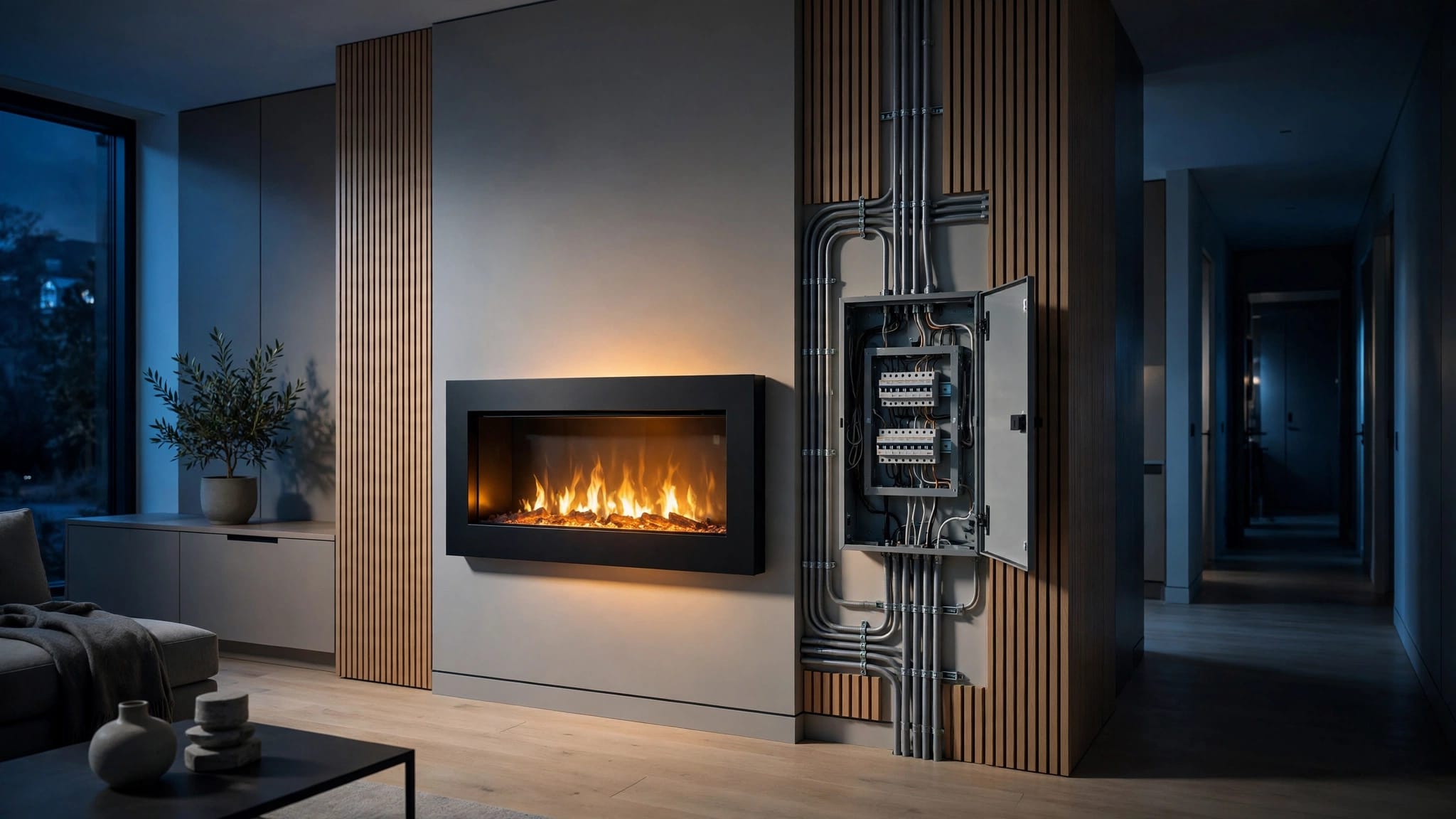
An electric fireplace can look like a simple living room upgrade until the breaker trips during the first cold evening. The heater, its location, and the home's existing wiring all affect whether the installation is safe.
For Greater Boston homeowners, an electric fireplace circuit is more than a nearby outlet. Its electrical requirements depend on the unit's nameplate, installation method, Massachusetts code, local AHJ, and the home's existing branch circuit and electrical service. The manufacturer's instructions and local AHJ control the project-specific decision.
Some electric fireplaces are rated for 120 volts, while larger models may be rated for 240 volts.
Start with the equipment details before selecting a fireplace surround or opening a wall.
Key Takeaways
- Start with the fireplace nameplate and installation manual. They identify the unit's voltage, wattage or amperage, connection method, and any dedicated-circuit requirements.
- A 1,500-watt fireplace draws about 12.5 amps at 120 volts, but circuit selection must also account for continuous heating loads, conductor size, other connected loads, and manufacturer instructions.
- Plug-in 120-volt models and hard-wired 240-volt models have different installation requirements. Never choose a breaker, wire size, or voltage based on a similar-looking fireplace.
- Avoid extension cords, power strips, and hidden adapters for sustained heating loads. Warm receptacles, burning odors, buzzing, flickering, and repeated breaker trips require the fireplace to be taken out of service and evaluated.
- Built-in installations may require permits, inspections, accessible connections, and coordination with the local Inspector of Wires. A licensed electrician should review both the branch circuit and the home's total electrical service capacity.
Start With the Fireplace Nameplate and Manual
The nameplate is the most reliable starting point for electric fireplaces. It lists the unit's voltage, wattage or amperage, and sometimes its wattage requirements and amperage requirements. The listed voltage may be 120 volts. The manual identifies the connection. It states whether the unit is plug-in, uses a power cord and receptacle, requires a dedicated circuit, or must be hard-wired.
A fireplace's appearance doesn't reveal its heat output or electrical demand. A slim wall-mounted model and an electric fireplace insert may look similar. Similar-looking electric fireplaces can still have very different wiring requirements.
Convert watts to amps before choosing a circuit
Use this simple calculation as a planning estimate, not a complete circuit-design method:
Watts divided by volts equals amps.
A 1,500-watt fireplace on 120 volts draws about 12.5 amps. A 750-watt unit draws about 6.25 amps at 120 volts. These figures reflect the heater operating at full output, not merely the flame-effect lighting.
A 1,500-watt heater doesn't automatically fit every 20-amp branch circuit. Account for continuous heating use, other loads, conductor size, listed instructions, and local approval before selecting a circuit.
Check the rating plate instead of relying on sales-page descriptions. Manufacturers may sell similar-looking units in different electrical configurations, including a model rated for 240 volts.
Decorative flames and active heat are different loads
Many units let you run flame effects without heat. LED lights may use less power in that mode, so the flame-only power draw is often modest. Once the heater turns on, the electrical load rises sharply.
A unit rated at 750 or 1,500 watts usually produces less heat than central heating equipment. Still, it can run for long periods in a chilly Boston-area family room. Treat the heater's listed load and expected operating duration as the deciding factors when planning the circuit.
The flame display may use little power, but the resistance heater controls branch-circuit planning whenever heat is active.
When an Electric Fireplace Circuit Needs Its Own Breaker
A dedicated circuit supplies one appliance or fixed piece of equipment. A shared circuit supplies several outlets, lights, or devices. The distinction matters because a fireplace heater can consume most of the circuit's available capacity by itself.
A dedicated circuit is common for built-in electric fireplaces, higher-output heaters, and models whose manuals call for one. It also keeps unrelated room devices from competing with the heater for power.
Fixed electric heaters are continuous loads
Massachusetts adopted the 2026 edition of NFPA 70, the National Electrical Code, as the current state electrical code. Under Article 424, a fixed heating appliance may be treated as a continuous load when it meets the applicable code classification and listing conditions.
Confirm the current Massachusetts code edition, the manufacturer's listing and instructions, and the local AHJ's interpretation before applying that classification.
For a qualifying fixed heating appliance, branch-circuit conductors and overcurrent protection may need sizing at no less than 125% of the connected heater load. A 1,500-watt heater at 120 volts draws 12.5 amps. Applying the 125% rule produces a required circuit load of 15.625 amps.
That calculation often points to a 20-amp circuit, subject to the listed equipment instructions and local approval. This example doesn't mean every model requires a dedicated circuit or a particular breaker. The manual, listing, calculated load, and local AHJ's interpretation determine what the installation needs. A unit operating at 240 volts still must follow its listed load and circuit instructions.
Shared circuits can create predictable problems
A plug-in fireplace may be permitted by its manufacturer to connect to a standard receptacle. Yet a shared circuit still needs enough circuit capacity for the heater and every other electrical load connected to it.
A typical 15 amp breaker circuit at 120 V has 1,800 watts of theoretical capacity. For a continuous-load planning limit, 80% equals 1,440 watts. Therefore, a 1,500-watt heater does not leave a practical margin on that example.
When a shared circuit also serves a vacuum, coffee maker, hair dryer, window air conditioner, or space heater, nuisance tripping is likely. Repeated trips of the circuit breaker are a warning, not an inconvenience to work around.
Comparing 120-Volt and 240-Volt Fireplace Options
Most consumer electric fireplaces use 120 volts and a standard household plug. These units are popular because many homes already have compatible receptacles. Compatibility alone doesn't prove that the existing circuit is suitable.
Higher-output electric fireplaces may use 240 volts and require a fixed connection. They may provide more heat than comparable 120-volt designs, but performance varies by model. Any installation still needs a properly sized breaker, conductors, disconnecting means where required, and panel capacity.
For a quick comparison:
- 120 volts: Commonly paired with an approved cord-and-receptacle connection. Circuit suitability remains model-specific.
- 240 volts: Commonly paired with a fixed connection. Breaker and wiring requirements vary by model.
Some units rated for 240 volts may deliver greater heat output with different amperage requirements than comparable 120-volt designs. Power draw still varies by model, so the nameplate controls the comparison.
A 120-volt fireplace fits more locations
A model that operates at 120 volts can work well in a bedroom, finished basement, or den. It can also suit an apartment-style accessory space where supplemental heat is the goal. Many models are rated around 750 to 1,500 watts.
An electric fireplace insert may fit a built-in feature wall, but its specific listing controls the installation. Before connecting a unit rated for 120 volts to an existing receptacle, check its manual's plug, circuit, and clearance requirements. A standard-looking plug doesn't make an extension cord or power strip acceptable.
A 240-volt unit may suit larger rooms
A fireplace using 240 volts may suit a large open-concept room, finished addition, or built-in feature wall. Its heat output varies by manufacturer and operating mode, and some fixed units can approach 8,500 to 9,000 BTUs per hour.
Unlike plug-in models, hard-wired fireplaces don't use a plug behind the unit. For a hard-wired installation involving 240 volts, a licensed electrician should determine the breaker and conductor sizes. They should also confirm disconnecting means where required, panel capacity, and wiring method. The manufacturer may specify a particular circuit arrangement or disconnect method for a model rated for 240 volts.
For any electric fireplace circuit, the nameplate and manual control. Never select breaker size or voltage based on a similar-looking model, including one rated for 240 volts. Follow the manual's electrical requirements before installation.
Why Extension Cords and Power Strips Are Poor Choices
Electric fireplaces may use a properly grounded wall receptacle only when the manufacturer permits plug-in, cord-and-plug operation with the approved cord. An extension cord, outlet splitter, or power strip adds connection points that can overheat under a sustained heating load.
A heavy-duty cord isn't a safe workaround and can still conflict with the fireplace manufacturer's instructions. It can also end up under rugs, behind furniture, or pinched by the fireplace enclosure. Those conditions hold heat where it doesn't belong.
Install the receptacle where the manual allows it
Built-in fireplace manuals often identify an approved receptacle location. Some allow a receptacle behind the appliance, while others require one in an adjacent cabinet or another accessible area. The manufacturer-approved power cord must reach that location and remain accessible when the equipment is designed for cord-and-plug connection.
Do not hide a power strip or an extension cord inside a framed chase to reach the fireplace. If the cord doesn't reach an approved receptacle, the home needs a properly planned receptacle or hard-wired connection.
Watch for overload symptoms
Flickering lights, a warm receptacle cover, a burning odor, buzzing, or a circuit breaker that trips when heat starts may indicate an overloaded circuit. Stop using the fireplace and arrange an electrical evaluation instead of repeatedly resetting the breaker.
An electrician can identify which receptacles share the branch circuit, inspect the wiring condition, and determine whether the issue is load-related or equipment-related. Older homes may have mixed wiring histories, especially after basement or attic renovations.
Greater Boston Permits, Inspections, and Local Code Review
Electrical work for built-in electric fireplaces often requires a permit and inspection in Massachusetts, but requirements vary by installation and municipality. The local authority having jurisdiction, usually the municipality's Inspector of Wires, reviews the work and applies local procedures.
If a project falls near a Massachusetts electrical code transition, the applicable code may depend on the electrical permit date. Confirm the governing code edition with the local electrical department before work begins.
Do not cover new wiring before inspection
Massachusetts rules prohibit concealing electrical installations before inspection. For a fireplace wall, this affects cable routing, junction boxes, receptacles, and hard-wired connections before drywall and finish materials go up.
A licensed electrician can coordinate the permit, rough inspection, final inspection, equipment documentation, and code-compliant installation work. Local practices can differ in Boston, Burlington, Cambridge, Newton, Somerville, and other communities, so confirm the process before construction starts.
For projects that involve new circuits inside walls, review what to expect with Massachusetts electrical rough inspections.
The local authority has the final say
State building codes provide the framework, but the local Inspector of Wires administers permits and inspections. The inspector may ask for the fireplace manual, product listing information, and circuit details. Those details may include whether the unit uses 240 volts, plus access to the connection point.
Municipal procedures and adopted code editions can change. Confirm the electrical requirements for your address with the local building or electrical department before ordering equipment or closing the fireplace wall.
Check Room Circuits and Whole-Home Capacity
A circuit can have enough capacity on paper while the main electrical service lacks room for another major load. A dedicated circuit can solve a branch-circuit issue without resolving inadequate service capacity.
This is more likely in older Greater Boston homes with 60-amp or 100-amp service, electric cooking, laundry equipment, central air conditioning, heat pumps, EV charging, or equipment that operates at 240 volts.
A licensed electrician reviews both levels. First comes the branch circuit serving the fireplace. Then comes the whole-home service load calculation for the entire home.
Add up the loads already on the circuit
A room-circuit review starts by identifying what the breaker actually feeds. The breaker label may say "living room," but it could also supply a hallway, porch receptacle, basement lights, or part of a nearby bedroom. That can leave an overloaded circuit even if the label doesn't identify every connected load.
Add up the electrical load of devices likely to run with the fireplace. For example, a 1,500-watt fireplace, 250-watt television, 120-watt sound system, and 100 watts of lighting total 1,970 watts. On a 120-volt circuit, that is roughly 16.4 amps before a vacuum or holiday lights enter the picture. That total exceeds the 1,800-watt rating of a 15 amp breaker and helps assess circuit capacity.
These figures are useful for planning, but they aren't a code-compliant design. The professional must evaluate the breaker rating and continuous-load rules. Fixed heating equipment needs the 125% sizing treatment, and the professional must verify conductor size, wiring condition, and circuit layout.
Panel space and wire size matter too
A new circuit requires an open, suitable breaker position in the electrical panel or another code-compliant solution. Its conductors must match the circuit rating and installation conditions. Common residential examples include 14 AWG copper for 15-amp circuits and 12 AWG copper for 20-amp circuits; these examples aren't universal.
Long circuit runs can cause voltage drop, especially in additions, garages, and detached structures. The professional may specify larger conductors after considering the breaker, wiring method, terminals, temperature, run length, and applicable code.
If your panel is crowded, outdated, or already supports several large electric loads, start the whole-home review with electrical load calculations for homes. A load calculation can show whether a new branch circuit is enough or whether the service needs attention.
Plan the Fireplace Wall Before Finishes Go Up
The best time to solve electrical details is before the mantel, tile, stone, drywall, and other finishes conceal the installation. The fireplace opening may need a recessed box, approved cable route, accessible junction point, and separation from heat-producing components as described in the manual. The connection method determines whether the unit needs an accessible receptacle, a hard-wired connection, an approved junction arrangement, or another manufacturer-specified solution.
Coordinate the licensed electrician with the fireplace installer, carpenter, and finish contractor to avoid misplaced receptacles, inaccessible connections, or rework. Electric fireplaces range from built-in designs to cord-connected products, and some are rated for 240 volts. Follow each manufacturer's listing and instructions to confirm the wiring route, circuit arrangement, and panel capacity before closing the wall.
Leave access for service and future changes
A hard-wired unit needs a connection arrangement that meets its listing and remains serviceable as required. A plug-in unit needs a reachable, approved receptacle for its power cord. Neither should depend on hidden adapters or improvised wiring.
Keep the electrical panel accessible as well. The fireplace circuit breaker should have a clear, accurate label so a homeowner or service technician can identify it quickly.
For homes that need more breaker space or a safer panel arrangement, breaker panel installation and replacement can address the larger electrical issue alongside the fireplace project.
Frequently Asked Questions
Does an electric fireplace need a dedicated circuit?
Not every electric fireplace requires a dedicated circuit. The manufacturer's instructions, listed load, continuous-load considerations, existing branch-circuit loads, and local AHJ determine whether a dedicated circuit is needed.
Can I plug an electric fireplace into a regular outlet?
A 120-volt model may use a standard grounded receptacle when the manufacturer permits cord-and-plug operation. The receptacle and branch circuit must still have sufficient capacity, and an extension cord, power strip, or outlet splitter should not be used as a workaround.
Is a 240-volt electric fireplace better than a 120-volt model?
Neither voltage is automatically better because performance and installation requirements vary by model. A 240-volt fireplace may provide greater heat output, but it commonly requires hard-wired installation, a properly sized breaker and conductors, and confirmation of panel capacity.
Do I need a permit for an electric fireplace circuit in Massachusetts?
Built-in fireplace wiring and new circuits often require a permit and inspection in Massachusetts, but requirements vary by municipality and installation. Confirm the process and applicable code edition with the local electrical department before covering wiring with drywall or finish materials.
Can an electric fireplace overload my home's electrical service?
Yes. A new branch circuit may resolve an overloaded room circuit without resolving limited whole-home service capacity, especially in older homes or homes with electric cooking, heat pumps, air conditioning, or EV charging. A licensed electrician can review the fireplace circuit and perform a whole-home load calculation when needed.
A Safe Fireplace Starts With the Right Circuit
Electric fireplaces can add warmth and character without straining a home's wiring. The right setup follows the listed unit's nameplate and manual, considers its actual demand, and recognizes that heat ratings such as BTUs don't replace electrical nameplate information.
For Greater Boston homes, a nameplate may specify 240 volts, but not every model uses that configuration. Circuit design, service capacity, permits, inspections, and local AHJ review should follow the listed unit, not assumptions about voltage, amperage, breaker size, or heat output.
A properly sized electric fireplace circuit protects the equipment, wiring, and people using the room. Have a Massachusetts-licensed electrical professional verify the installation when new wiring, a new circuit, service changes, permits, or inspections are involved.