

Snow Melt System Electrical Requirements in Massachusetts

Contact Us
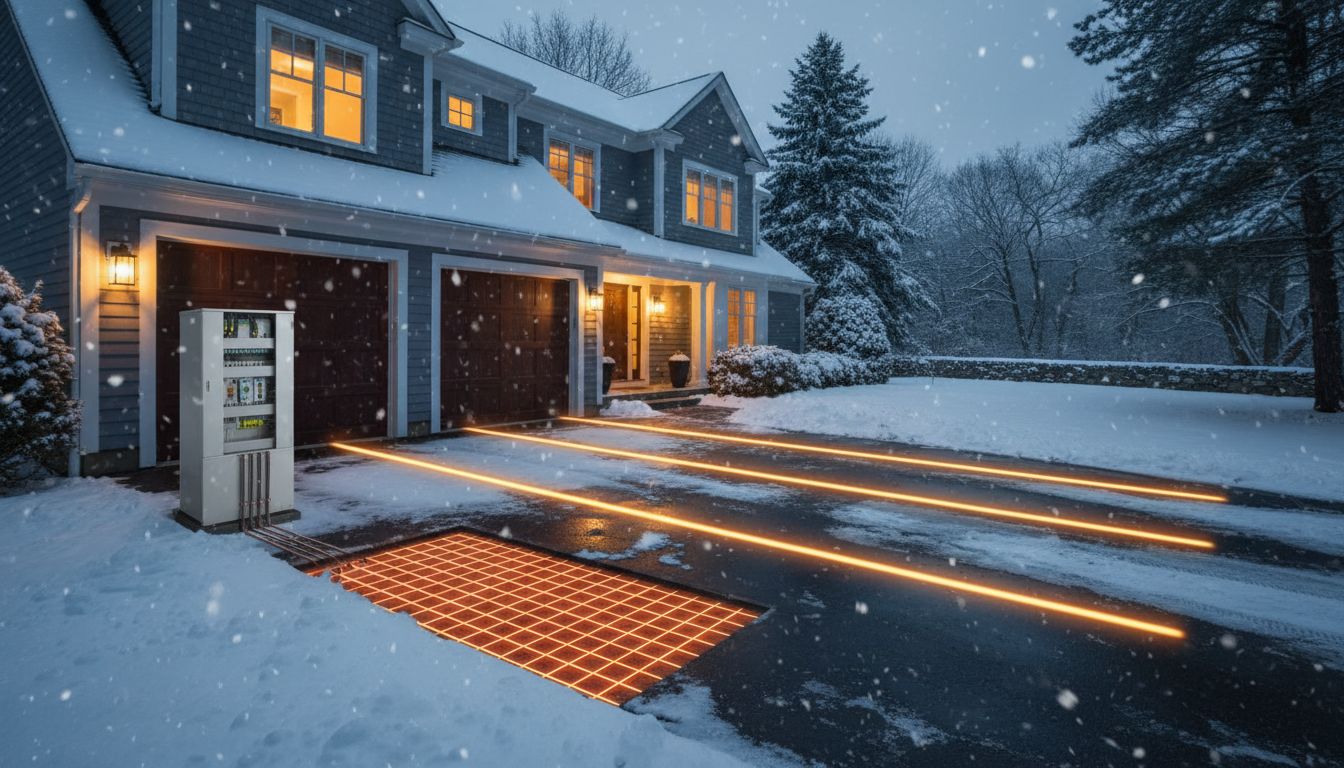
A heated driveway providing reliable snow removal can clear winter accumulation before it bonds to the pavement, but the electrical demand of radiant heat may rival that of several major household appliances. Planning the snow melt system electrical requirements early helps you avoid an undersized panel, unexpected utility work, or a driveway that cannot support the chosen snow melt system.
Massachusetts homeowners also need to account for local permits, the adopted electrical code, service conditions, and the driveway surface. A licensed electrician must complete the site-specific load calculation and installation. The planning details below will help you ask better questions before work begins.
Key Takeaways
- Electric snow melting mats and snow melting cables often require 240-volt circuits and substantial amperage.
- The national electrical code addresses fixed outdoor electric de-icing and snow-melting equipment under Article 426.
- The system is generally treated as a continuous load, so circuit calculations use more than the heater's running amperage.
- Ground-fault equipment protection, dedicated circuits, disconnecting means, and listed equipment are important design details.
- Massachusetts electrical requirements can vary by adopted code edition, municipality, utility, and existing service capacity.
Understanding snow melt system electrical requirements
The first calculation for any snow melt system starts with the heated area. Electric driveway systems commonly use about 37 to 50 watts per square foot, although the final design depends on the product, pavement, climate exposure, insulation, and performance goal.
A 20-by-20-foot driveway contains 400 square feet. If the chosen heating element delivers 50 watts per square foot, the heating load would be about 20,000 watts. At 240 volts, that equals roughly 83 amps before applying continuous-load requirements. At 120 volts, the same heater would draw about 167 amps.
That difference explains why many larger systems use 240 volts. Higher voltage reduces current for the same wattage, although it does not reduce the total energy the system consumes. A 240-volt installation still needs correctly sized conductors, breakers, equipment grounding, and protection.
Manufacturers may publish different design figures. ProLine Radiant, for example, gives a residential heating density of about 37 watts per square foot and describes a 30-amp circuit serving approximately 170 square feet in one example. Another product may require a different circuit arrangement. Use the heater's installation manual rather than applying a generic number to every system.
The heating zone also affects the calculation. Homeowners often weigh full coverage against tire track coverage, choosing between heating the entire pavement or focusing only on tire paths, slopes, steps, or a walkway. Reducing the area lowers the electrical demand, but the zone layout must match how snow will move and where ice creates a hazard.
Panel capacity matters more than breaker space
A panel with an open slot doesn't automatically have enough capacity for a snow-melt heater. The electrician must calculate the home's existing load, then add the proposed heating element as a continuous load.
The calculation may include the range, electric water heater, heat pumps, air conditioning, EV charger, well pump, sump pump, generator, and other significant loads. A 100-amp service may already operate close to its practical limit. A 200-amp service can also fall short when the home has electric heating, vehicle charging, or several large appliances.
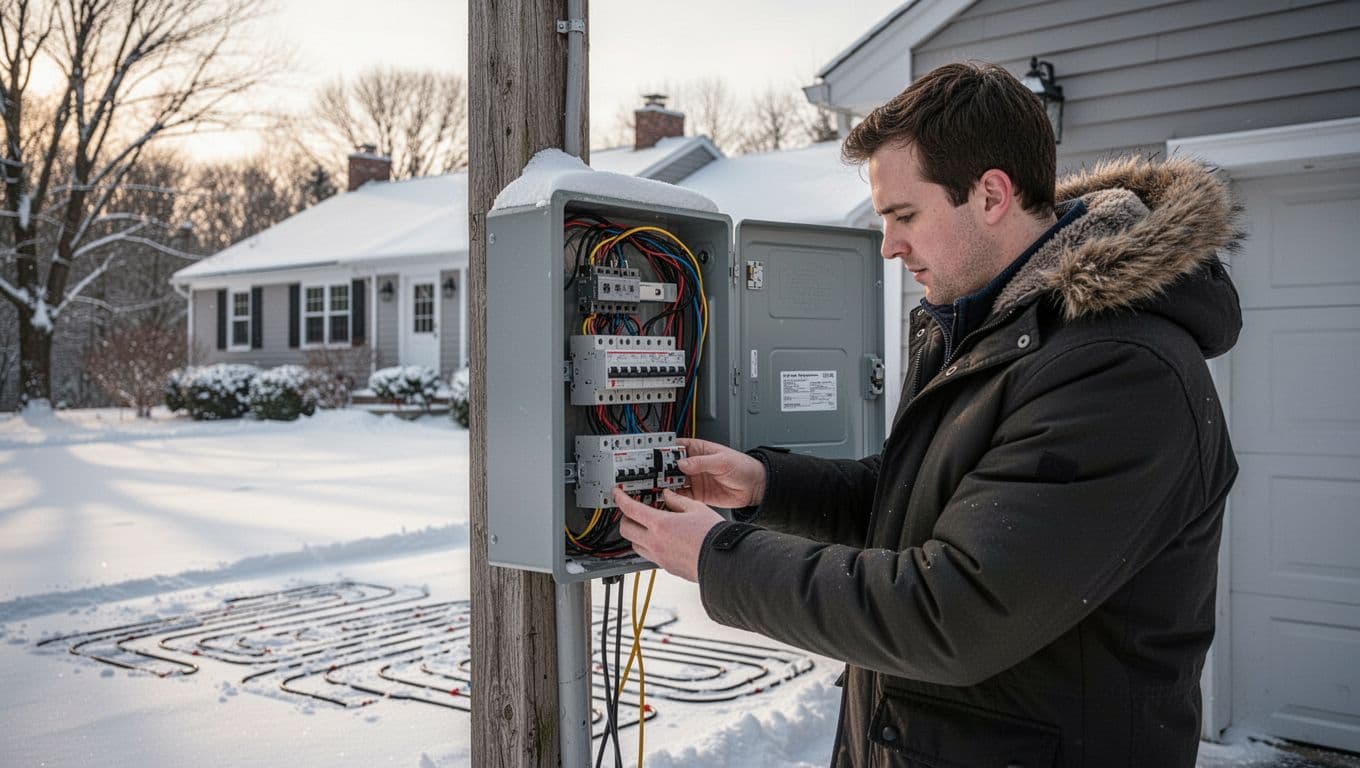
NEC Article 426 covers fixed outdoor electric de-icing and snow-melting equipment. Sources describing this article identify the heater as a continuous load, which generally requires circuit capacity at 125% of the calculated load according to the national electrical code. For example, an 83-amp power consumption figure could produce a design metric near 104 amps before the electrician evaluates the complete circuit and equipment arrangement.
That example doesn't mean a homeowner can install a 104-amp circuit breaker. The correct solution may involve multiple branch circuits, a larger feeder, a separate distribution panel, or a service upgrade. The heater manufacturer may also set maximum circuit sizes and maximum heater currents.
If the existing service cannot support the project, review the likely scope before ordering equipment. Comparing 100-amp and 200-amp electrical service can help explain why an electrical service upgrade often becomes necessary when whole-home load calculations reveal high power demands.
Circuits, protection, and disconnects
A driveway snow-melt system needs more than power at the panel. The installation usually includes dedicated circuits, outdoor-rated equipment, a control panel, temperature or moisture sensors, and a disconnecting method that the homeowner or service technician can access.
The exact circuit count depends on the heated area and the manufacturer's limits. A 350-square-foot example may require two 30-amp circuits or a larger arrangement, while a much larger driveway can require several circuits routed through a central relay panel. Field wiring typically terminates in a weatherproof junction box before connecting to the heating elements. The electrician will select conductor sizes and overcurrent protection based on the calculated load, installation method, terminal ratings, ambient conditions, and product instructions.
Ground-fault equipment protection, commonly called GFEP, is a major part of the design. Manufacturer instructions for snow-melt products often call for GFEP protection, with some systems specifying 30 milliamp protection for each circuit by utilizing a dedicated gfep breaker. GFEP protects the equipment and wiring from damaging ground faults. It isn't always the same device or trip level as personnel GFCI protection.
The National Electrical Code has also included an exception involving certain dwelling outdoor outlets that supply electric snow-melting or de-icing equipment on single-phase circuits rated 150 volts to ground or less and 50 amps or less. That provision doesn't remove the need to follow the heater listing, Article 426, or other applicable protection requirements. Massachusetts may be enforcing a particular NEC edition with state amendments, so the local authority having jurisdiction must confirm the applicable rule.
Article 426 also addresses listed equipment, disconnecting means, grounding, and conductor installation. A breaker may serve as the disconnect when it meets accessibility and other requirements. The final design should identify how each circuit can be shut off during maintenance.
Voltage, wiring route, and driveway construction
Electric snow-melt systems may be available in 120-volt or 240-volt configurations. Product availability, system size, panel capacity, and the distance between the panel and driveway affect the selection.
Long wiring runs can increase voltage drop and may require larger conductors. The electrician must also select a wiring method suitable for the route. A circuit running through a basement, exterior wall, conduit, trench, or detached garage faces different conditions. Burial depth, physical protection, wet locations, and transitions into outdoor equipment all matter.
Cold lead cables connect the heating elements back to the power source, and this connection must be housed inside a junction box located outside the driveway slab. Contractors use snow melting cables or snow melting mats depending on the layout, and an asphalt installation requires products specifically rated for high temperatures. Paver projects may use systems designed for placement beneath the pavers. Retrofitting an existing driveway often requires removal of the surface, saw cutting, or a separate design that avoids damaging the heating elements.
Before excavation, identify septic systems, irrigation, drainage, lighting, low-voltage wiring, and utility lines. The electrical contractor also needs a clear route back to the panel. That route may affect trenching, conduit, pull boxes, and restoration costs.
Controls deserve attention during planning. A snow sensor can start the system when moisture and low temperatures occur, while a temperature sensor can help prevent unnecessary operation. Manual controls may be useful for testing, but automatic controls reduce the chance that the system stays on after a storm. The control equipment still needs a suitable location, weather protection, and access for service.
Massachusetts permits, utilities, operating costs, and operating cost
Massachusetts homeowners should contact the building or electrical department in the municipality where the property sits. Local code enforcement practices, permit forms, inspections, service requirements, and adopted amendments can differ between communities. The utility may also require approval when the project changes the service, meter, service entrance, or available capacity.
A service upgrade can involve more than replacing the panel. Older homes may need new service conductors, grounding and bonding corrections, meter work, weatherhead changes, utility coordination, or additional code corrections. For current Greater Boston planning ranges, see this guide to electrical service upgrade costs. The actual price depends on the property and utility scope.
Operating cost deserves equal attention because the operating cost heavily influences long term utility bills. A 400-square-foot radiant heat system rated at 20 kilowatts uses 20 kilowatt-hours for every hour it runs. At an electric rate of 30 cents per kilowatt-hour, that equals about $6 per operating hour. Actual runtime depends on snowfall, temperature, sensor settings, insulation, and the system's control strategy, especially when replacing manual snow removal on an asphalt driveway.
Greater Boston planning estimates often place electric power consumption and snow melt operation around $0.10 to $0.20 per square foot per hour, with installation commonly ranging from $10 to $30 per square foot. Those figures are broad planning ranges, not a quote. Surface removal, trenching, panel work, controls, and service upgrades can change the total sharply.
A practical planning sequence
Start by measuring the area you want heated and deciding early whether you need full coverage or tire track coverage. Separate the driveway, walkways, steps, ramps, and other zones, then identify the pavement type and whether the project is new construction or a retrofit.
Next, choose your materials by comparing options like a heating cable, snow melting cables, and snow melting mats. The electrician needs the rated voltage, watts per square foot, total wattage, maximum circuit current, required protection, control requirements, and installation instructions for your chosen heating element, alongside automated controls like a snow sensor and temperature sensor. Product data should come from the manufacturer, not a general online calculator.
Then schedule a site review before finalizing the driveway design. The electrician can inspect the panel, service conductors, grounding, available circuit space, route, and existing loads. If the panel needs replacement, breaker panel installation and replacement may be part of the project, but only a load calculation can determine whether the service itself must change.
Finally, confirm permits and inspection requirements with the local Massachusetts authority. Ask who will coordinate utility work, how the system will be tested, where the disconnect will be located, and what documentation the homeowner will receive.
A snow-melt design can fit inside a new panel and still exceed the home's service capacity. The load calculation must evaluate both.
Frequently Asked Questions
Do snow melt systems require a dedicated electrical circuit?
Yes, electric snow-melting mats and cables typically require dedicated circuits to handle their substantial electrical load safely. Depending on the size of the heated area, multiple branch circuits or a separate distribution panel may be necessary.
Why is a load calculation required for a snow melt system in Massachusetts?
Snow melt systems draw significant continuous power that can rival major household appliances. An electrician must perform a whole-home load calculation to determine if your existing electrical panel and service size can support the added demand without overloading.
What is ground-fault equipment protection (GFEP) and why is it needed?
GFEP is a specialized safety feature often specified by manufacturers for outdoor heating systems to prevent damaging ground faults. It differs from standard personnel GFCI protection and helps safeguard the equipment and wiring from electrical hazards.
Can I install a snow melt system on any existing driveway?
Retrofitting an existing driveway is possible, but it often requires saw-cutting, surface removal, or specialized products designed for specific materials like asphalt or pavers. You must also account for the electrical routing, cold lead connections, and panel capacity before beginning any work.
Conclusion
Electric driveway heating in Massachusetts requires early coordination between the driveway contractor, heating system manufacturer, electrician, municipality, and utility. The central questions are the heated area, wattage, voltage, circuit arrangement, ground fault protection, panel capacity, and service rating.
When you plan for full coverage using durable snow melting cables and a properly sized heating element, you ensure reliable snow removal all winter long. Because a large snow melt system can draw significant current before continuous load calculations, professional design is necessary, especially in homes with electric heat, EV charging, or older services. By carefully evaluating the electrical requirements and calculating the expected operating cost ahead of time, you can finalize the layout before concrete, asphalt, or pavers go down, giving your driveway project a clear path to safe and code compliant operation.